
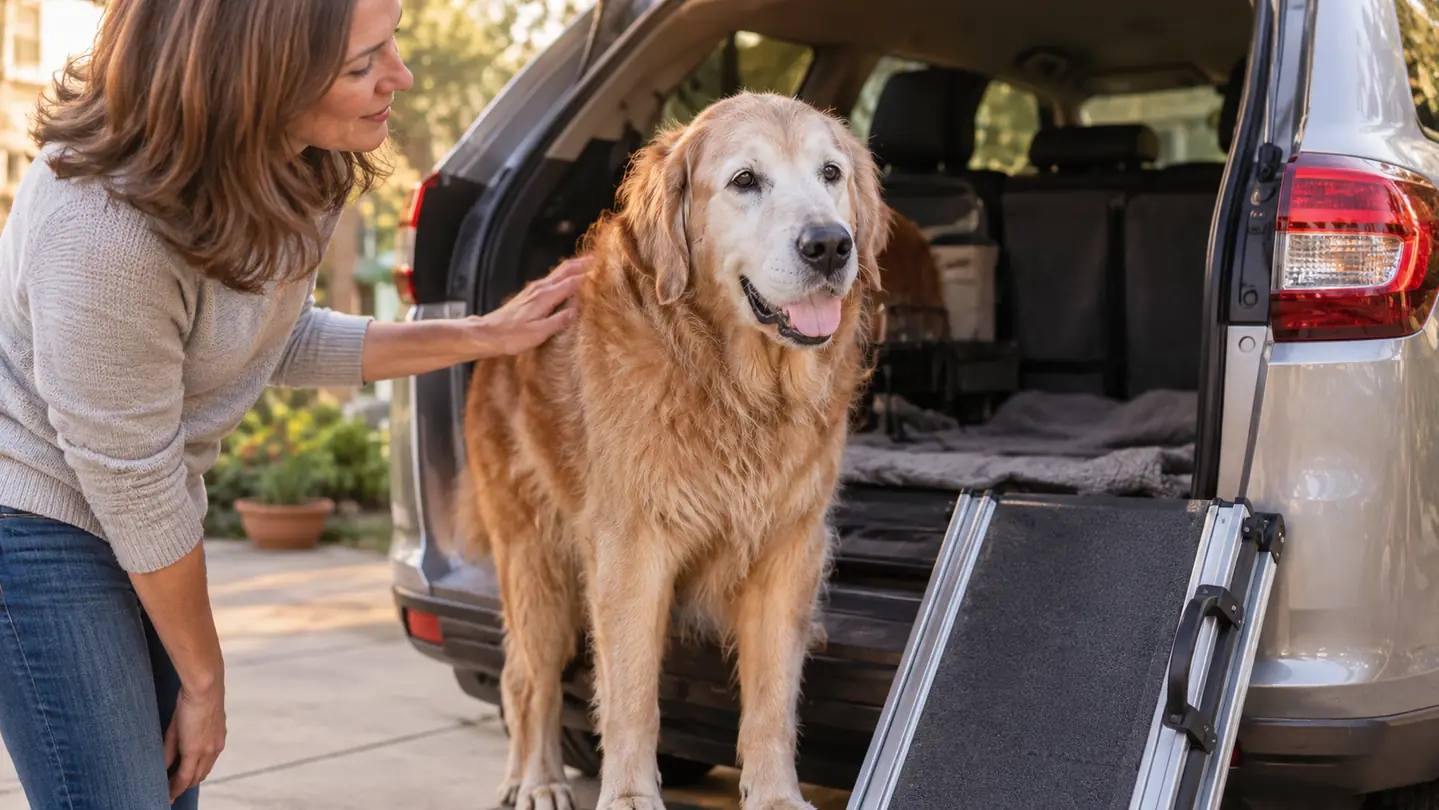
Biscuit is twelve years old, sixty-eight pounds, and a Golden Retriever, which means she spent most of her life believing she could get into anything without help. The back of our 2019 Subaru Outback is where that belief finally met its match. Her back legs would go first, then she would stop, then she would turn and look at me. I bought the PetSafe Happy Ride folding ramp about eight months ago, the week after I lifted her into the hatch and felt something pull in my own shoulder. This is the review I wish I had read before I ordered it, including the parts that are not on the product page.
Here is the honest shape of it. The ramp works. It ended the two-person lift into the Outback, and at sixty-three with a bad shoulder that alone was worth the shelf space in the garage. But a ramp is a simple piece of equipment and the reasons it succeeds or disappoints are not simple at all. There were two weeks where Biscuit would not put a paw on it. There are still mornings when she needs the sling for the three wooden steps off our deck, because the ramp lives in the car and the deck steps are a different problem. Knowing that going in would have saved me a few days of thinking I had bought the wrong thing.
The Quick Verdict
A light, well-made ramp that genuinely solved the Outback for my sixty-eight pound Golden, once I accepted that it is a tool you have to teach, seat and store, not a fix that installs itself.
Amazon Check Today's Price →The Ramp That Ended the Two-Person Lift Into the Outback
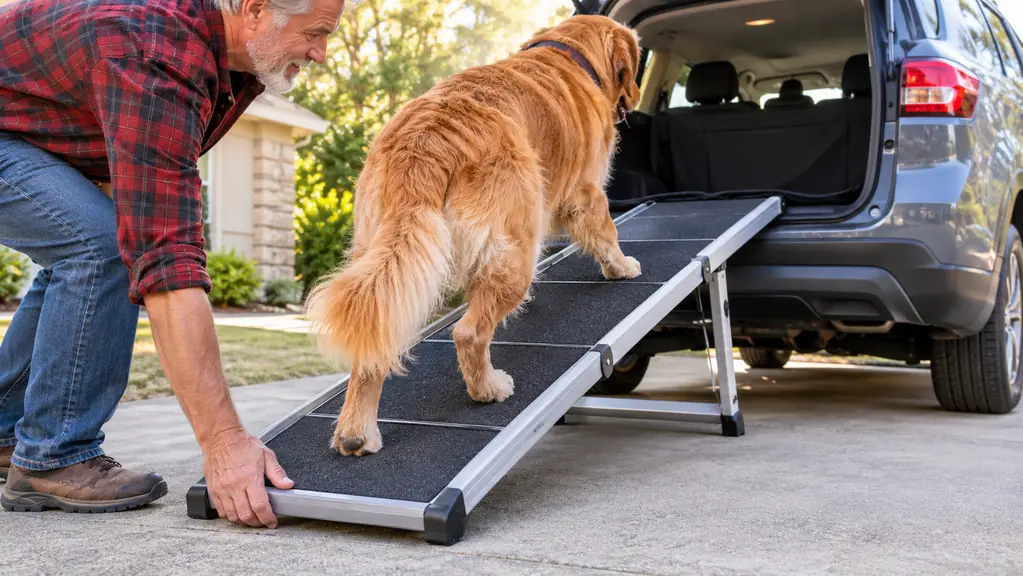
Sixty-two inches long, sixteen wide, ten pounds, rated to one hundred fifty. It rides folded in the cargo area and sets up in about fifteen seconds once you have the hang of it. That is what it did for us.
Amazon Check Today's Price on Amazon →The Part Nobody Mentions: You Have to Teach a Dog to Walk Up a Ramp
Nobody told me this and it is the single most useful thing I know now. A dog does not look at a ramp and understand it. Biscuit looked at it the way she looks at the vacuum cleaner. For the first three days I set it flat on the living room floor with no height at all and just fed her treats standing beside it. Day four I put a treat on the low end and let her stretch for it. Day six she put one front paw on it and immediately took it off. That is normal. If you expect the dog to trot up it the first afternoon you will decide the ramp is defective and return it, and the ramp will not have done anything wrong.
What worked, in the end, was peanut butter smeared at nose height partway up the ramp and my husband Dale standing at the top with a second spoon. Two short sessions a day, maybe five minutes each, and no pushing, ever. Pushing is what sets you back a week. Biscuit is food motivated enough that she would follow a spoon into a volcano, so by day twelve she was walking up on her own and by day fourteen she was doing it without the spoon. A dog who is not food motivated will take longer and that is not a flaw in the dog or the ramp. It is just the work.
I say all this because the reviews that say the dog loves it and the reviews that say the dog will not use it are often describing the same product and different amounts of patience. The ramp is not self-teaching. The first week I thought I had wasted the money. The third week I stopped thinking about it at all. Once it is taught, it stays taught. Biscuit has not hesitated at the base of it in about seven months.
Ten Pounds Cuts Both Ways
The PetSafe Happy Ride is listed at ten pounds, and that is the number that made me buy it. I can carry it out to the car with one hand and a coffee in the other. I can set it against the bumper without asking Dale for help, which matters more than I expected it to, because the whole point was to stop needing a second person for a job that happens three or four times a week. A heavier ramp might feel more substantial. It would also sit in the garage, because I would not haul it out for a short trip to the park.
The same ten pounds is the honest downside. A light plastic ramp has to be seated properly or it will shift, and I learned that the annoying way. If I set it at even a slight angle to the bumper, Biscuit's first step would nudge it sideways an inch or two and she would stop and look back at me. Now I set it square, press down until I feel the four rubber feet take hold, and check that the safety release latch is fully released and locked open. Fifteen seconds of fuss. Skip it and the dog notices before you do.
The length is the other half of it. Sixty-two inches is a real span, and it means the angle is gentle, maybe the gentlest part of the whole design. A short ramp on a tall hatch is a staircase. A long ramp on the same hatch is a sidewalk. Biscuit is twelve with arthritis in both hips and both elbows, and she walks up this one without the little gather-and-hop she used to do onto a folding step stool. I would not trade the length for anything, even though it is the reason the folded ramp takes up a third of the cargo area.
Ten pounds is why I can set it up alone at sixty-three, and it is also why the ramp has to be seated square every single time.
Sixteen Inches Is Narrower Than It Sounds
Sixteen inches of width is fine for Biscuit, who is a lean sixty-eight pounds and walks a reasonably straight line. It is not generous. A friend's Rottweiler mix is broader through the chest, and I watched him crab-walk up it once and catch a back paw on the low side rail. He made it, but he made it crooked. If your dog is wide, or tends to walk up things at an angle, or panics, measure the dog's stance before you order. The side rails are low and they are there to give a paw something to feel, not to keep a determined dog from stepping off.
For a dog who is nervous rather than wide, the narrowness is less of a problem than the openness. There is nothing on the sides of this ramp to make a dog feel enclosed. Some dogs want that. Biscuit does not care either way, but I have watched her think about it on a windy day. On those days I stand at the base with a hand flat on the underside of the ramp, which steadies it and gives her something to read as reassurance. It is not a technique from a manual. It is just what worked.
The Rubber Feet Are Only as Good as the Ground
Four rubber feet, and on our concrete driveway they do exactly what they are supposed to do. The ramp does not slide, does not skate, does not walk itself away from the bumper. Our driveway is flat, which is the part I did not think about until the first time I used it at my sister's house, where the drive runs downhill toward the street. On that slope the ramp sat at a strange angle and I ended up moving the car rather than trusting it. If your parking spot is on a grade, plan around it. That is not the ramp's fault, but it is your problem to solve.
Wet weather is the other one. The treads are high traction when they are dry and they are still decent when they are wet, but a dog with muddy paws coming out of the Boise foothills in February is a different calculation. I wipe Biscuit's feet before she loads now, which I should have been doing anyway. And I do not let her go up the ramp at speed. A dog at a walk is fine. A dog who decides to launch herself up it like a dock into a lake is asking for a paw to slide, and that is true of any ramp made of any material.
What It Did Not Fix
I want to be very clear about this, because I think some people buy a ramp expecting it to be the whole answer. It is not. The three wooden steps off our back deck are still there, and on a bad morning Biscuit still needs the LOOBANI sling under her hind end to get down them. The PetSafe ramp lives in the car. It does not help with stairs, it does not help with the hardwood in the hallway, and it does not help her get up off the floor after a long nap. For that last one the rug and the orthopedic bed do more than the ramp ever will.
It also did not replace anything our vet told us to do. Biscuit was diagnosed with hip and elbow arthritis at ten, and she has been on Cosequin since that same week, along with the weight management and the two short walks a day instead of one long one. The ramp is one piece of a plan. It removes one specific hard moment from her week, the jump into the hatch, and it removes it well. If you are looking for something that will make a twelve-year-old dog young again, no ramp on the market will do that and you should not expect this one to.
The place it earns its keep is the vet's parking lot. That sounds like a small thing and it is not. Twice a year Biscuit goes in for her check, and both times I used to arrive already tense about the lift, then stand in the lot trying to work out how to get her out without hurting either of us while a stranger held the door. Now I open the hatch, set the ramp, and she walks down it herself. The whole transaction takes under a minute. If you have ever done that dance in a parking lot with a stiff dog, you know exactly what a minute is worth.
Storing It in an Outback
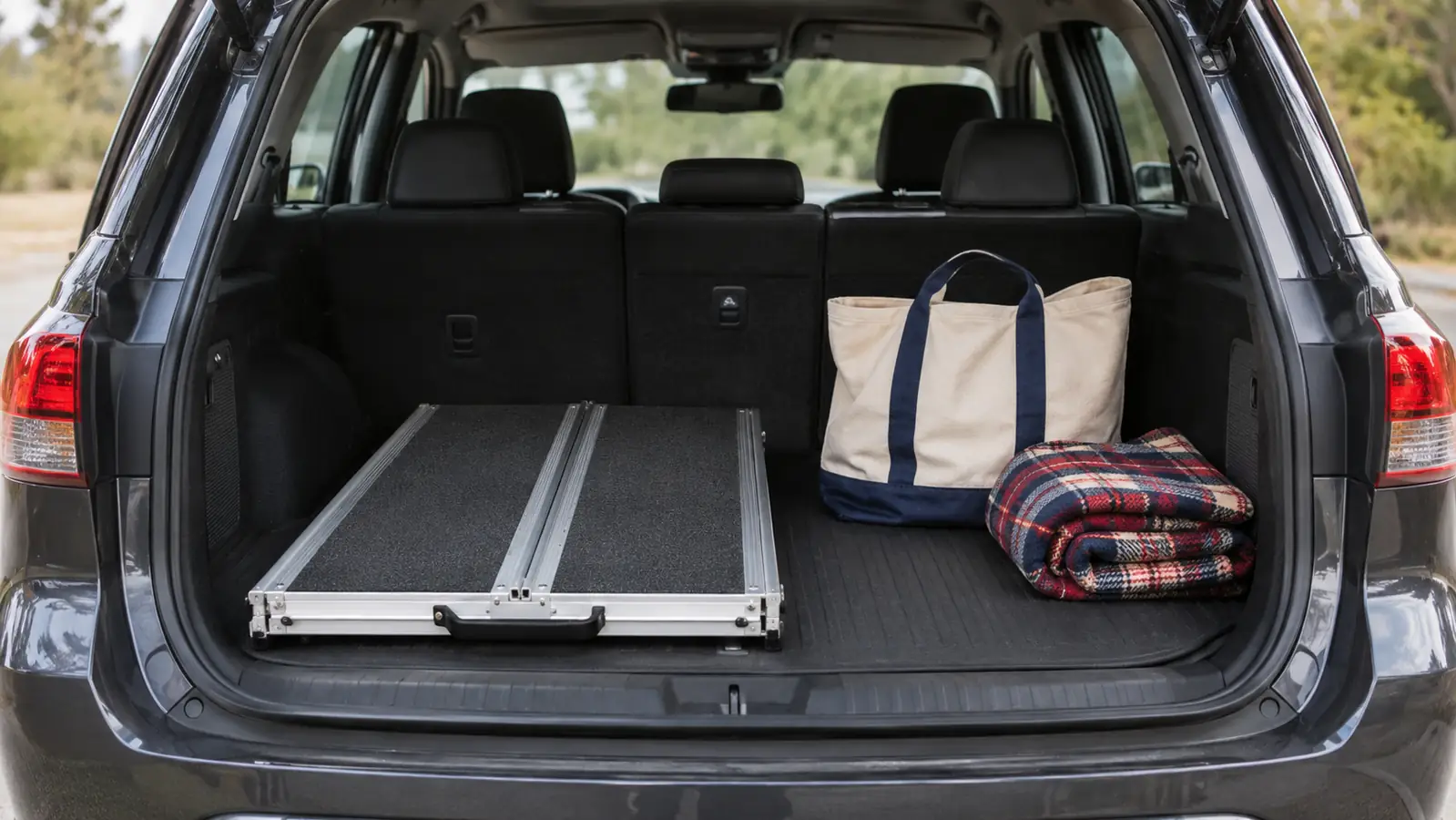
Folded, it is about four inches thick and sixty-two inches long, which in the back of an Outback means it lies flat along the cargo floor and eats roughly a third of the width once you leave room for the grocery bags. It does not fit neatly under anything. In eight months I have not once taken it out of the car except to wipe it down, because the moment I take it out is the moment I need it at the vet's office. That is the trade. You give up some cargo space permanently and you get to stop planning around the dog.
If you drive a smaller car, or you need the full cargo area regularly, the folded length is the number to pay attention to rather than the weight. Sixty-two inches is longer than a lot of people picture when they read the words folding ramp. Measure your cargo area with the seats up before you order. I did not, and I got lucky.
What I Liked
- Ten pounds, so I can set it up alone in about fifteen seconds
- Sixty-two inches gives a gentle angle that suits an arthritic dog
- Rubber feet hold firm on flat concrete and the treads grip well in the dry
- Folds flat and stays in the cargo area, so it is always with the car
Where It Falls Short
- A light plastic ramp shifts if you do not seat it square every time
- Sixteen inches of width is tight for a broad or unsteady dog
- Some dogs need two weeks of daily treat sessions before they will use it
- Sixty-two inches folded takes real cargo space in a smaller vehicle
Who This Is For
This is for the owner of a dog who can still walk but cannot comfortably jump, and who has a vehicle with a hatch tall enough that the jump is the problem. Biscuit is a textbook case: sixty-eight pounds, arthritis in both ends, still active, still wanting the ride to the park. The ramp gives her a way to get in with dignity instead of being hoisted. It is also for a person who is starting to feel the lifting in their own back and shoulders, which is the part I did not expect to matter as much as it did. Two bodies get spared here, not one.
Who Should Skip It
Skip it if your dog cannot bear weight on all four legs, because a ramp needs the dog to walk up it and a sling or a lift is the honest answer. Skip it if your dog is broad enough that sixteen inches is genuinely tight, or if your dog panics at anything new and you are not prepared to spend two weeks on it. Skip it if your parking is on a slope and you cannot change that. And skip it if what you actually need is help with stairs, because this does not do stairs and I would hate for you to find that out in the rain.
Eight Months In, It Is Still in the Car
If your dog can still walk and the jump into the hatch is the thing that has gotten hard, this is the ramp that ended the lift in our house. Ten pounds, sixty-two inches, rated to one hundred fifty.
Amazon Check Today's Price on Amazon →