
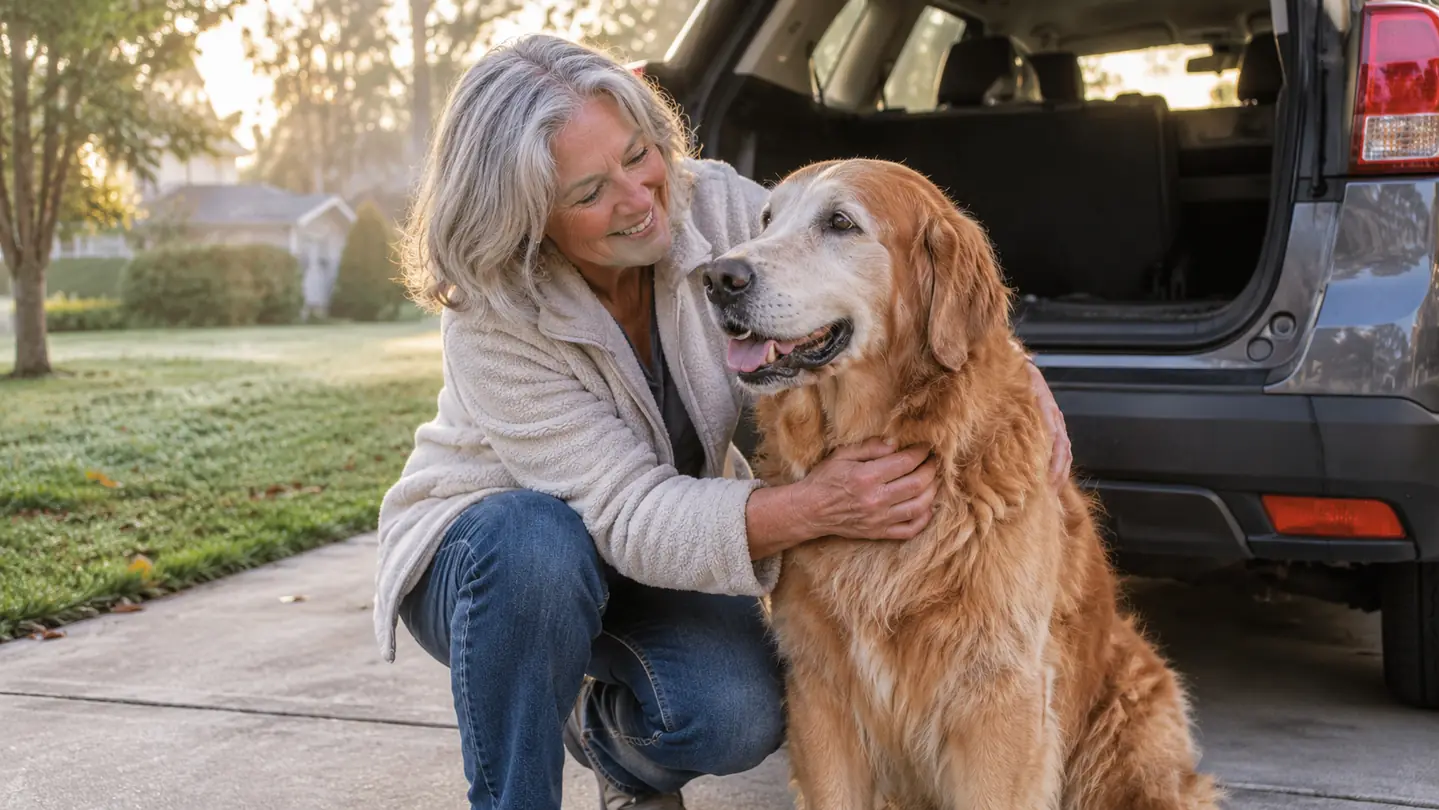
Biscuit is twelve years old, sixty-eight pounds, and arthritic in both hips and both elbows. The cargo floor of our 2019 Subaru Outback sits about twenty-six inches off the driveway. For two years that number was my problem and not hers. I would stand behind the car, brace my feet, scoop her up under the ribs, and set her on the cargo mat. Some mornings she made a small sound before I had her a foot off the ground, and I pretended not to hear it. Eight months ago I started using the PetSafe Happy Ride folding ramp for that one job. I have lifted her twice since, both times in the rain, both times a mistake I regretted by dinner.
Here is the short answer, since that is what you came for. The ramp is better for your back and better for the dog. Lifting is better for speed, for cost, and for any dog who will not put a paw on a surface she does not trust. Those are not small advantages and I am not going to pretend otherwise. If you have a thirty-pound dog, a dog who still hops in on her own, or a hatch that sits low, lifting is fine and you do not need to buy anything. If you have a sixty-eight-pound Golden with sore hips and you are sixty-three years old, lifting is an argument you have with your own spine four times on a vet day. Most people in my position end up using both, and that is where we landed.
| PetSafe Happy Ride ramp | Lifting her in | |
|---|---|---|
| What it costs | One purchase, and everything you need is in the box: the ramp, the rubber feet, the latch. | Nothing. You already have arms. |
| Time from parked to loaded | About thirty seconds to unfold it, set the feet square, and line up the hatch. | Five seconds if she cooperates. Longer if she does not. |
| Your back and shoulders | She walks. You spot her. | Sixty-eight pounds, four times on a vet day. |
| Pressure on sore joints | She sets her own pace on the treads, one paw at a time. | A forearm under the ribs and a hand under the hips still press on the sore spots. |
| A dog who yelps when scooped | No lift at all. She walks up on her own. | The yelp is how you find out it hurts. |
| A dog who refuses new surfaces | Biscuit took about two weeks of treat sessions. Some dogs never accept it. | Works on the first try, every time. |
| Doing it herself | She gets into the car under her own power. That matters more than it sounds. | She is cargo. |
| Space in the car | Folds to roughly sixty-two by sixteen by four inches and lives in the cargo area. | Takes up no room at all. |
| Wet, icy, or muddy mornings | The treads are high traction, but ice is ice, and I skip it then. | Weather does not change anything. |
Where the Ramp Wins
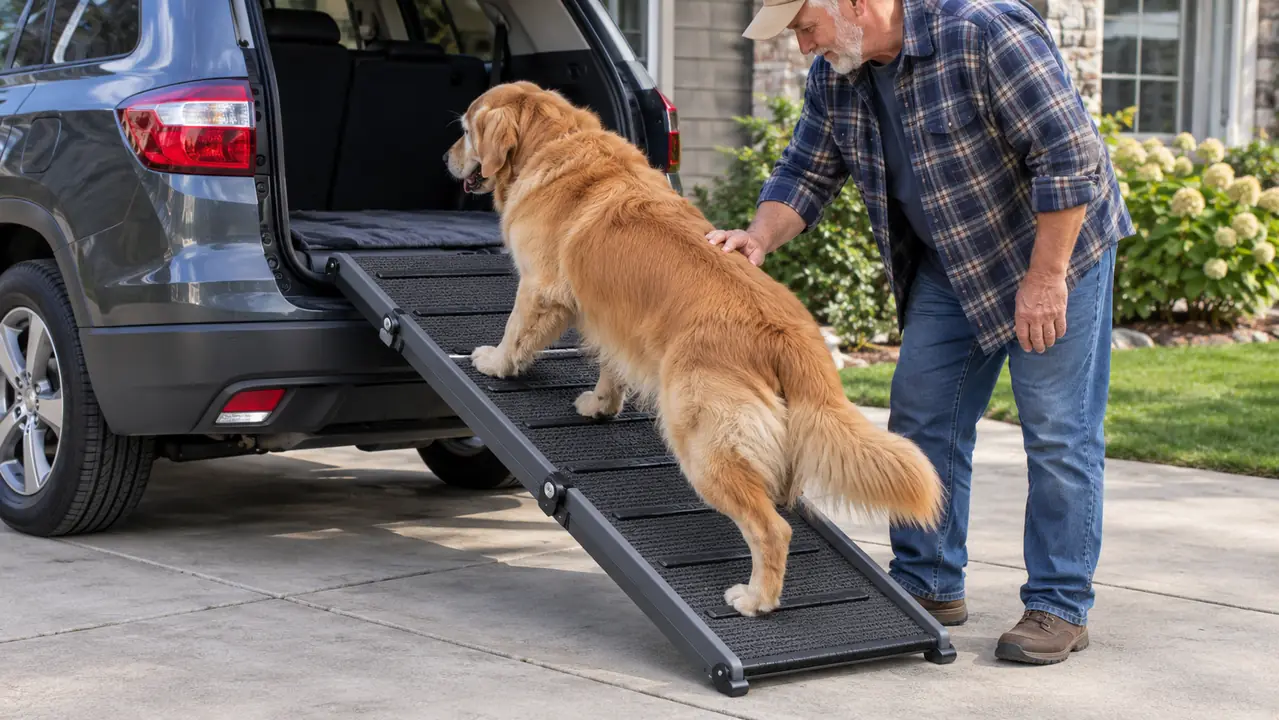
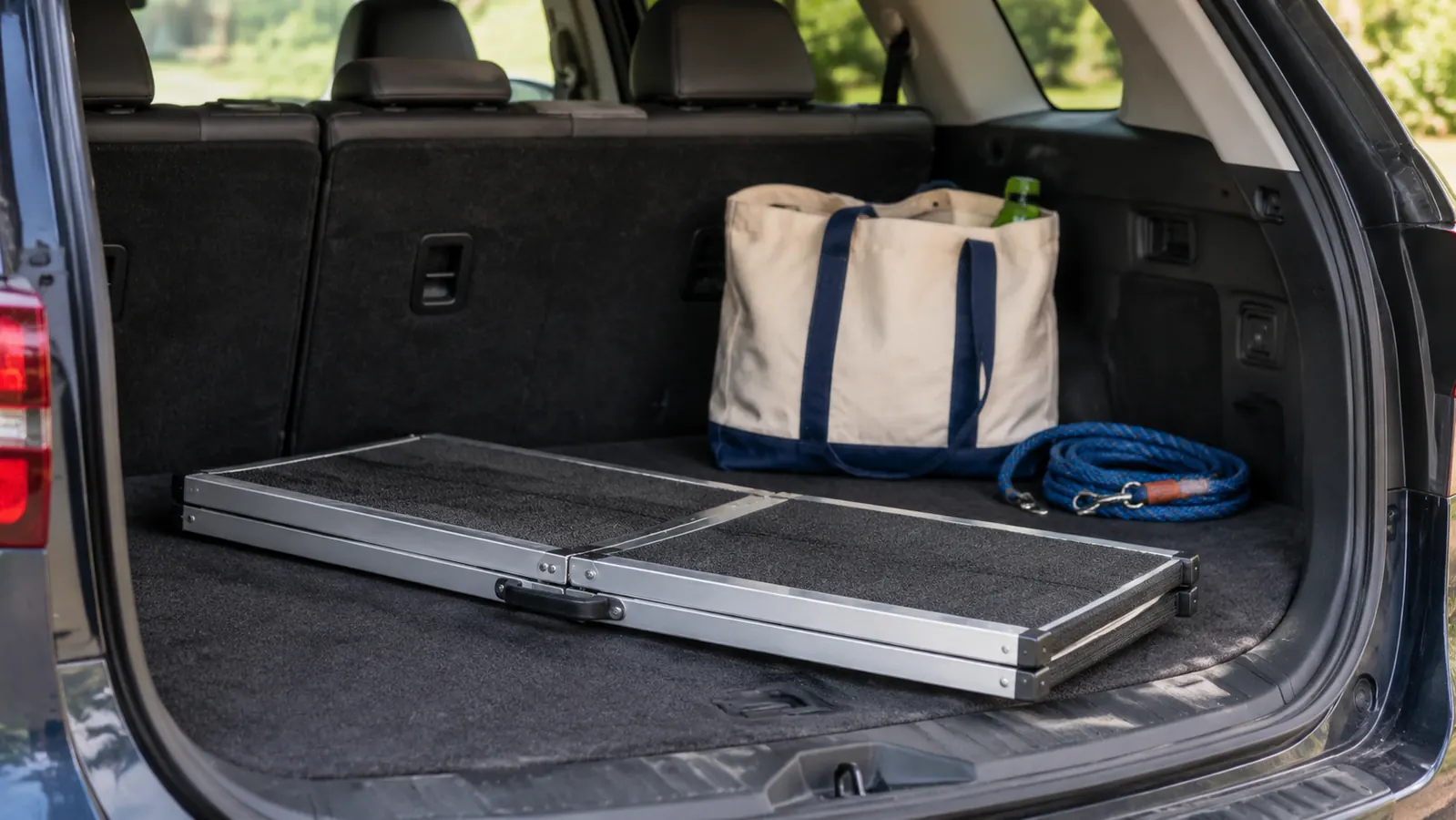
The first thing the ramp gave me was my back, and I want to be specific about why that mattered. A vet visit is four lifts: into the car, out at the clinic, back in, out at home. Sixty-eight pounds, four times, and that is before the dog is nervous and leaning the wrong way. The ramp weighs ten pounds and I can carry it with one hand while the leash is in the other. It folds flat and rides in the cargo area behind the second row. The first time I unfolded it at the hatch I stood there feeling foolish for not doing this a year sooner.
The second thing it gave me was a dog who is not being handled when she is sore. Scooping a big dog means a forearm under the ribs and a hand under the hips, and both of those are exactly where arthritis lives. On the ramp she walks. The treads are textured, the side rails give her an edge to see, and the four rubber feet keep the base from walking on the concrete apron. It is rated for a hundred and fifty pounds, which is more than twice her weight, and I like that margin on a morning when she wobbles halfway up. The PetSafe ramp does not make her younger. It just stops me from squeezing her sore parts twice a day.
The third thing is harder to put in a sentence. There is a difference between a dog who is placed somewhere and a dog who goes there herself. When Biscuit walks up that ramp, she is doing the thing, not having the thing done to her. She gets to the top, turns around, and waits for me to close the hatch, and she looks pleased with herself in a way she never did when I set her down like a sack of flour.
There is a difference between a dog who is placed somewhere and a dog who goes there herself.
Where Lifting Wins
Now the other side, because it is real. Lifting costs nothing and it is instant. I am not going to tell you a ramp is free or fast, because it is neither. You unfold it, set the feet square, check the latch is seated against the hatch, and line the dog up. On a good morning that is thirty seconds. On a morning when she has decided the front tire smells interesting, it is two minutes and a pocket full of treats. If your dog is small, or if you are still strong enough that the lift is easy, none of this is worth the trouble.
Lifting also wins with a dog who will not trust a new surface. Biscuit took to the ramp in about two weeks. A friend's terrier never took to hers at all, and no amount of treats changed her mind. Then there is ice. The treads are high traction and I have walked up them in running shoes to test, but ice is ice, and on the mornings when the driveway is glazed I do not use the ramp at all. Space is the other one. Folded, the ramp is about sixty-two inches long and sixteen wide, and in a small car that is room the groceries wanted. Those are honest tradeoffs and you should hear them from me rather than find them out in the rain.
What Eight Months Actually Looked Like
The first attempt was a failure and I want to be honest about that. I set the ramp on the concrete, put a treat on the third tread, and Biscuit stood at the bottom and looked at me as though I had asked her to walk a plank over a canyon. So we started smaller. Twice a day for about five minutes, the ramp flat on the ground, treats on the treads, no car involved. Then the ramp on the hatch with the engine off and the car quiet. By the end of the second week she walked up on her own and stood in the cargo area waiting for the rest of the treat. It was not a switch that flipped. It was a habit that got built, one boring session at a time.
Practically, the ramp lives folded in the cargo area behind the second row. The latch that holds it closed is the first thing I check, because in the first week I did not check it and the ramp unfolded halfway across the driveway while I was carrying it. The rubber feet sit on the concrete apron at the back of the driveway and not on the gravel, because gravel lets them sink and the angle goes wrong. The angle is the whole thing. Too steep and she balks at the bottom step. I park a little further out from the garage door now so the ramp has room to lie at a gentler pitch.
Upkeep is a hose and five minutes. Mud on the treads makes them slick, so after a wet walk I rinse them and let the ramp dry flat in the sun. Nothing has cracked, seized, or come loose in eight months, and the listing says a one-year warranty, which I have not had to test. I wipe the latch with a rag when it starts to feel gritty. That is the entire maintenance routine.
The Sling Does the Other Half
If you take one thing from this, take the division of labor. The ramp is for the hatch of the Outback and nothing else in our house. The three wooden steps down to the yard belong to the sling. We keep an LOOBANI hind-leg sling on a hook by the back door, and on a bad morning I loop it under her back legs and take some of her weight on the steps. It supports the rear only. It does nothing for her elbows and I would be lying if I said otherwise. Between the ramp, the sling, the Cosequin chews she has had for about eighteen months, and the orthopedic bed by the window, the car is one piece of a routine and not the whole routine.
The ten-pound ramp that ended the scoop in our driveway
The PetSafe Happy Ride folding ramp folds flat, rides in the cargo area, and carries a hundred and fifty pounds on high-traction treads with side rails. Biscuit learned it in two weeks with a pocket of treats.
Amazon Check Today's Price on Amazon →Mistakes I Made So You Do Not Have To
I set it too steep the first week and could not understand why she refused it. The hatch on a car parked close to the garage door gives the ramp a short, sharp angle, and a short, sharp angle is a wall to a sore dog. Move the car out, give it room, and the same ramp becomes a gentle walk. The second mistake was rushing the treat sessions. Five calm minutes twice a day did more than twenty minutes of me coaxing and clicking and generally being a nuisance about it.
The third mistake was the rain. One evening I decided the ramp was too much bother in a downpour and scooped her up just this once. My back was unhappy for two days and she was stiff for one. I am not telling you that to sell a ramp. I am telling you because just this once is how the lifting habit comes back, and it comes back fastest on the days you are tired and the weather is bad.
Who Should Buy Which
Buy the ramp if your dog is over fifty pounds and the jump into the car has gotten cautious. Buy it if you lift alone, if the hatch sits high, or if your dog has sore hips or elbows that a scoop presses on. Buy it if your dog is food motivated and will at least consider a new surface for a piece of chicken. The PetSafe Happy Ride is the one I know, eight months in, and I would buy it again for a dog Biscuit's size. What I would not do is buy it and expect it to work on day one without training.
Keep lifting, with a sling if you need one, if your dog panics or yelps on new surfaces, if you drive a small car, or if the dog is small enough that the lift is genuinely easy on you. Keep lifting if the weather where you live is icy half the year and you know you will not use a ramp on those mornings. And if your dog has just been diagnosed and you are still working out what is sore, talk to your vet before you buy equipment. Our vet is the one who told me to stop the jumping, and that conversation came before the ramp, not after.
Whatever you choose, watch your dog on the days she is stiff rather than deciding from a good day. The good days lie to you. The stiff mornings tell you what the car ride is actually going to be like for the next year.
Read the specs, then watch your dog on a stiff morning
Ten pounds, folds flat, sixty-two inches long, high-traction treads, side rails, and four rubber feet. It is not free and it is not instant. For a sixty-eight-pound dog with sore hips, it is the difference between riding and being loaded.
Amazon See It on Amazon →