
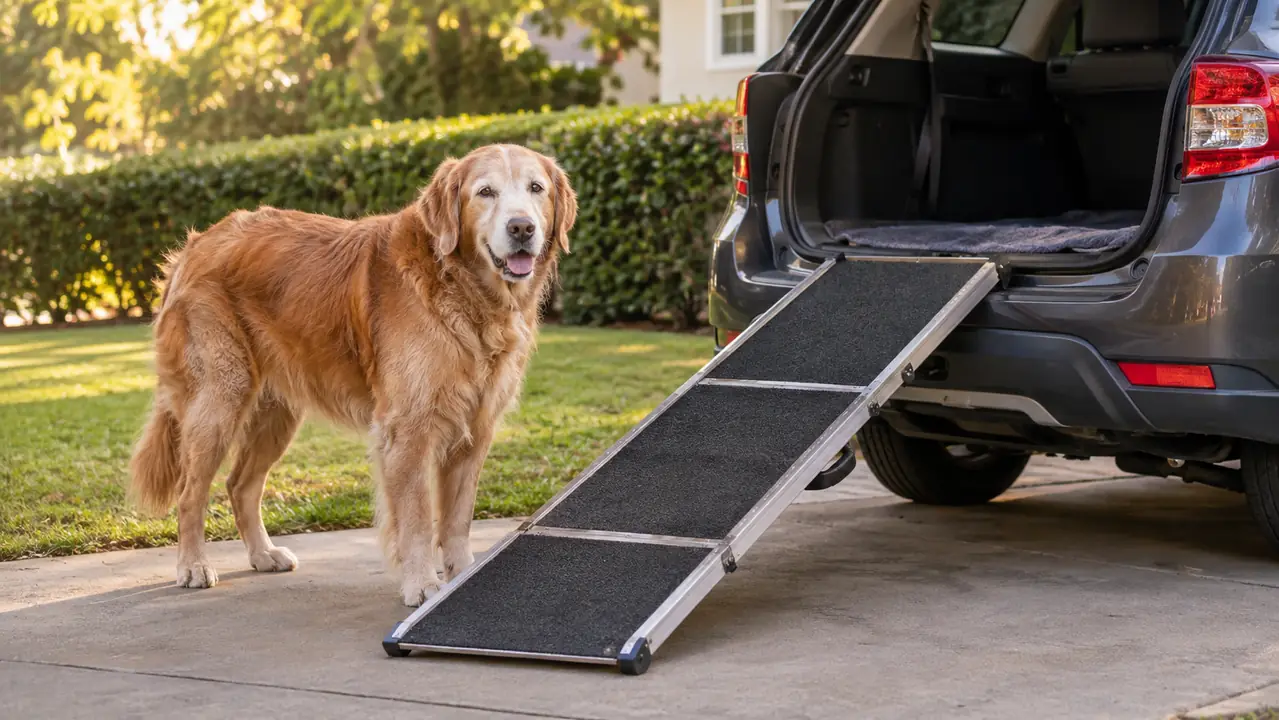
The first time I tried to load Biscuit into the back of our Outback, she sat down on the driveway and refused. She was ten then, sixty-eight pounds of Golden Retriever, and she had just been told by our vet that her hips and elbows were arthritic. I lifted her in that day. It took two tries and I felt it in my lower back for a week. That is the honest version of how this started, and it is why I have opinions about a folding ramp that weighs ten pounds.
The PetSafe Happy Ride Folding Dog Ramp has been in our garage for about eight months. It comes out for vet appointments, for weekend drives to the park, and for anything else that ends with Biscuit needing to get into the back of a 2019 Subaru Outback. It is not the only thing we bought. There is a sling on a hook by the back door, an orthopedic bed in the living room, a pair of socks for the hardwood, and a soft chew she takes with breakfast. But the ramp is the piece that changed how the two of us leave the house together. PetSafe makes a whole line of these mobility items, and this is the one I know best, so this is the one I will tell you about.
The Quick Verdict
Ten pounds, folds flat, and it gets a stiff sixty-eight pound dog into the back of an Outback without either of us paying for it the next morning.
Amazon Check Today's Price →The ramp that ended the driveway standoff
Sixty-two inches long, sixteen wide, folds in half and rides in the cargo area. Check the current price and the load rating on the listing before you decide.
Amazon Check Today's Price on Amazon →How I've Used It
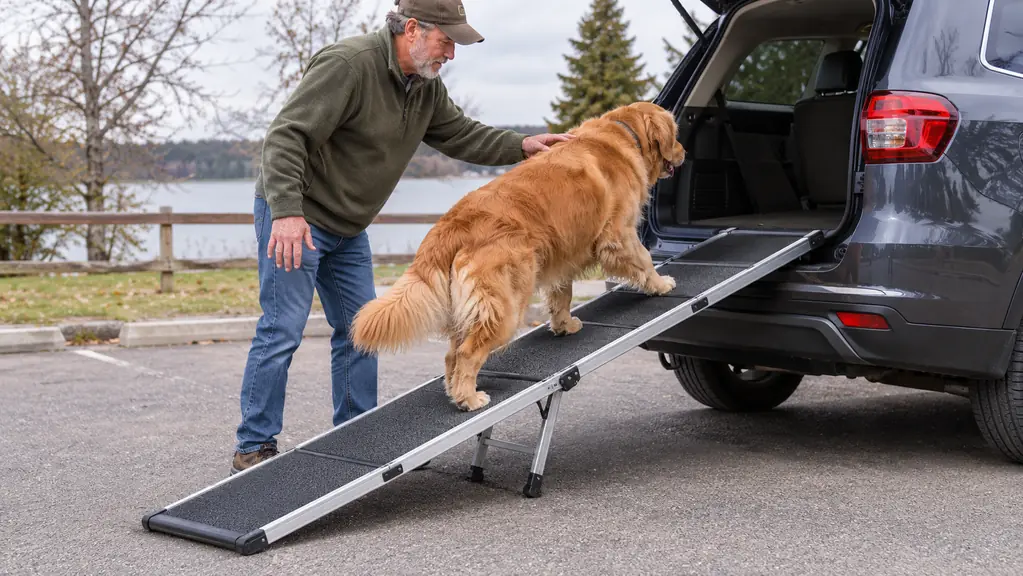
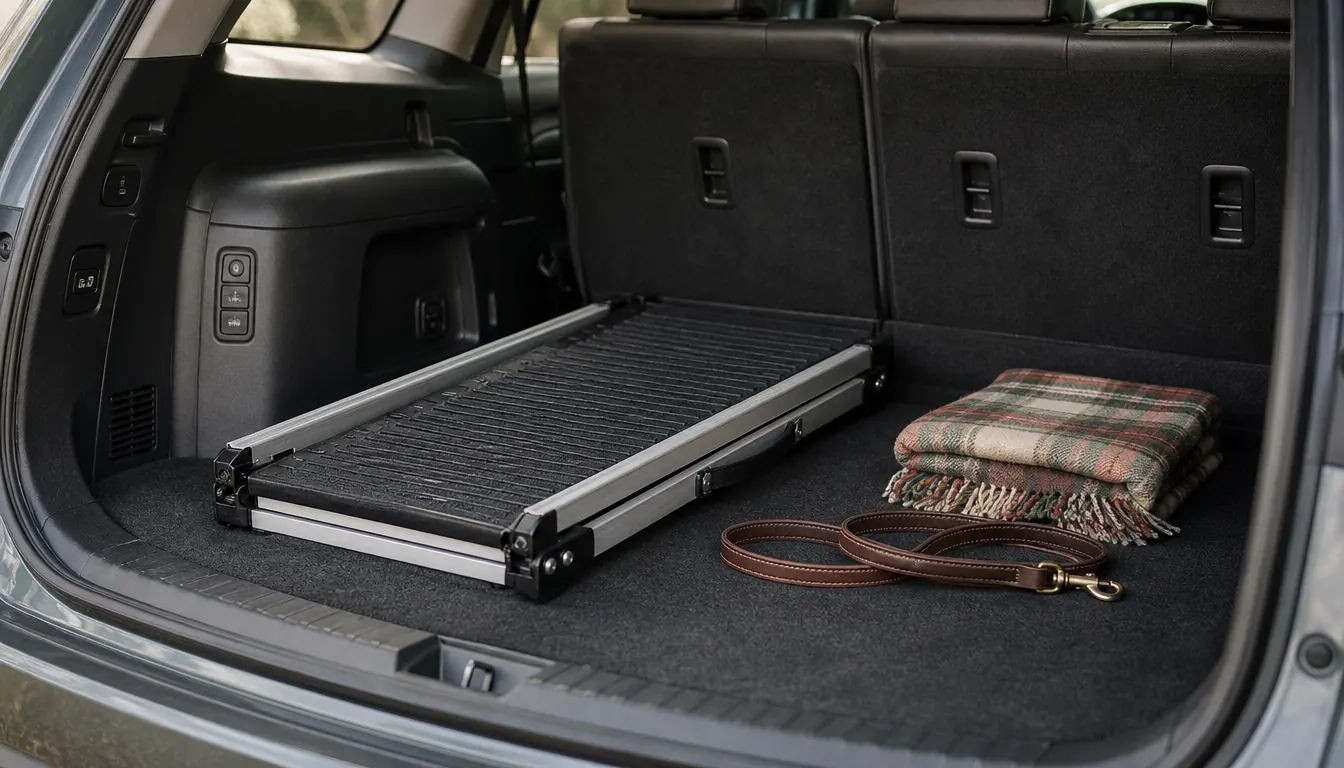
Ours lives folded in the cargo area of the Outback. That was the deciding factor when I was comparing options, and I want to be straight with you about it. I did not want a ramp that had to be stored in the garage and fetched every single time, because a ramp you have to go find is a ramp you will skip on the days you are already running late for the vet. This one folds in half and sits behind the back seat. When we arrive somewhere, I pull it out, unfold it, and hook the top edge on the bumper. The safety release latch is the part that keeps it from sliding off, and I check it every time, because I am sixty-three and I do not trust anything that holds my dog's weight to luck.
Biscuit uses it two to four times a week, more in the summer. In eight months that is somewhere north of a hundred trips up and down. She walks up on her own now. The first few times I kept the sling looped under her back end as a just-in-case and stood beside her with one hand near her flank, but I have not needed either in months. The treads are the reason. They are textured enough that her feet do not skate, and that matters with a dog whose back legs do not always go where she tells them.
I should say what it is not. It is not a shortcut for a dog who cannot walk. On Biscuit's bad mornings, the kind where she is stiff for the first few minutes after she gets up, she still needs the sling for the three wooden steps off our deck. The ramp does not fix her elbows and it does not fix her hips. What it does is remove one specific hard thing from her week, and it removes it reliably, every time, without me having to think about my back.
What We Tried Before This
Before the ramp, we tried three things. The first was me lifting her, which worked until it did not. She is sixty-eight pounds and she does not help, and by the end of last winter my back was telling me about it every morning. The second was a set of folding pet steps a neighbor lent us. Biscuit would not put a paw on them. They were narrow and they shifted when she leaned, and she is not a dog who forgives a wobbly surface. The third was the sling, which we still use, but a sling is for supporting her back end while she walks, not for getting her up into a vehicle. I tried it for the car once and it was awkward for both of us.
What I learned from that stretch is that a ramp has two jobs and I only expected one. The obvious job is getting her into the car. The other job is getting her to agree to it. The steps failed the second job. They were stable enough by my judgment, but not by hers, and hers is the judgment that counts. The ramp is wider, and the side rails give her something to feel against her shoulder, and that turned out to matter more than the incline itself.
What You Actually Get
The ramp is sixty-two inches long, sixteen inches wide, and four inches thick when folded. It holds up to a hundred and fifty pounds, which is more than twice Biscuit's weight, and I like that margin on a piece of plastic that my dog is standing on. It has side rails, which I did not think about until I watched her drift slightly to the left on the way up one afternoon and catch herself against the rail instead of stepping off the edge. That is the whole argument for rails, and I did not appreciate it until I saw it happen in front of me.
The frame is plastic, and yes, that is what the listing says, and yes, it feels like plastic when you pick it up. Ten pounds is light enough that I can carry it in one hand with my purse in the other. Light is good when you are the one hauling it around at sixty-three years old. Light is also the thing that made me skeptical at first, because light and sturdy do not usually live in the same sentence. Eight months in, the hinges are still tight, nothing creaks, and all four rubber feet are still where they started. It also comes with a one year manufacturer warranty, which I have not had to use.
The Two Weeks It Took to Teach Her
Biscuit did not walk up this ramp on day one. I want to say that clearly because I have read reviews that make it sound like you unfold it and the dog simply knows. She stood at the bottom and looked at it, then looked at me, then walked back toward the porch. So we did short sessions, twice a day, five minutes at most, with a treat at the bottom, a treat halfway up, and a treat at the top. By day four she would put her front feet on it. By day ten she went up with me steadying her. By two weeks she was doing it on her own without a pause.
The thing that helped most was putting it against the open hatch instead of setting it on flat ground in the yard. She already wanted to be in the car. The ramp was just the thing standing between her and the car. Once that connection landed, the hesitation mostly went away. If your dog is food motivated, this will go faster for you. If your dog is not, budget the two weeks and do not rush it, because a dog that gets spooked off a ramp at the start is much harder to bring back than one that never tried.
Ten pounds of plastic did what my back could not: it got her to the vet and home again without either of us paying for it the next day.
Eight Months Later: How It's Held Up
The treads are the part I expected to wear out first and they have not. There is some grit worked into them from wet parking lots, and I hose it off every few weeks, which takes about a minute. The rubber feet are all still attached, though one has a slight flat spot from the driveway. The latch still clicks. The fold still folds flat enough to sit behind the second row without shoving the groceries around. If I had one complaint about long term upkeep it is that the treads hold onto dirt, and something that lives in a garage is going to pick up whatever it rolls through.
Our Outback's rear opening is not unusually high, and the ramp reaches it comfortably at full length. What I cannot tell you is how it does on a lifted truck or a tailgate that sits much higher, because I have not tried it and I am not going to guess with your dog. The listing says it fits most SUVs, vans, cars and trucks, and I will take PetSafe at their word for the vehicles I have not parked in. If your hatch is much taller than ours, measure it before you order.
Where the Ramp Falls Short
It is bulky when it is open. Sixty-two inches is over five feet of ramp, and in a tight parking spot you are going to be the person taking up room behind the car while your dog makes her way up. I have learned to park at the far end of the lot for vet visits and that has solved it for me. But if you are working in a crowded garage or a narrow street, this is a genuine annoyance and I would not pretend otherwise just because it has been good to us.
The ramp is also light enough to shift. Ten pounds will slide if it is set on a slick surface at the wrong angle, and I have had it move an inch on a wet concrete pad when I was in a hurry and not paying attention. The rubber feet help and the latch helps, but neither one is a substitute for setting it properly and giving it a nudge with your foot before the dog commits her weight. That is a two second habit and you should build it from the first day.
And it does not solve stairs. I want to be honest about that because I spent a while hoping it would. Our deck has three wooden steps and the ramp does not help with them at all. That is what the sling is for, and the socks are for the hardwood inside. If your dog's only trouble is the car, this is your answer. If your dog's trouble is the car and the stairs and the slippery floor, this is one piece of a bigger plan, and you should expect to buy more than one thing.
What I Liked
- Folds in half and stores in the cargo area, so it is actually there when you need it
- Ten pounds, easy to carry in one hand while holding a leash
- Side rails caught a dog that drifted, which happened with us more than once
- Textured treads that a stiff dog will trust after a couple of weeks of treats
- Rated to 150 pounds, roughly double what our 68-pound dog weighs
Where It Falls Short
- Long when open, so tight parking spots are awkward
- The plastic frame feels light in the hand at first, even though it has held up
- Does not help with stairs, which I had hoped it would
- Takes a couple of weeks of short sessions before a cautious dog will use it
- Treads hold dirt and need an occasional hose-off
Who This Is For
This is for the person who is currently lifting a dog into a vehicle and feeling it in their back by the end of the week. Especially if the dog is over forty pounds and over eight years old, and especially if you drive an SUV or a hatchback with a rear opening about the height of ours. It is also for the person whose dog is not in crisis yet but is clearly thinking about the jump before she takes it, that little pause at the bumper. That pause is the moment to buy something, not the morning after she refuses.
It suits a household where one person does most of the driving, because the ramp lives in the car and travels with you. It suits a dog who is cautious but willing, the kind who needs a few days of treats and then settles in. And it suits anyone who has already tried steps and found them too narrow or too shaky, which was exactly our situation before this.
Who Should Skip It
Skip it if your dog cannot bear weight on the back legs at all. A ramp assumes the dog can walk up an incline, and that is a different thing from a dog who needs to be carried. Skip it if your vehicle's rear opening is unusually high or if you would have to set the ramp on a slope, because I have not tested either and I am not going to guess. And skip it if you are not willing to spend a couple of weeks teaching it, because a ramp a dog will not use is just ten pounds of plastic taking up room in your trunk.
One more thing, and I mean this. If Biscuit's stiffness had come on suddenly rather than gradually, or if she had started favoring one leg, I would have been at our vet before I bought anything at all. A ramp manages a problem. It does not diagnose one. Talk to your vet about what is actually going on with your dog's joints before you spend money on gear, and then buy the gear that matches what they tell you.
Eight months of vet runs, and my back has not complained once
Sixty-two inches, sixteen wide, ten pounds folded, rated to a hundred and fifty. If your dog is pausing at the bumper, this is the piece that ends the pause.
Amazon Check Today's Price on Amazon →