
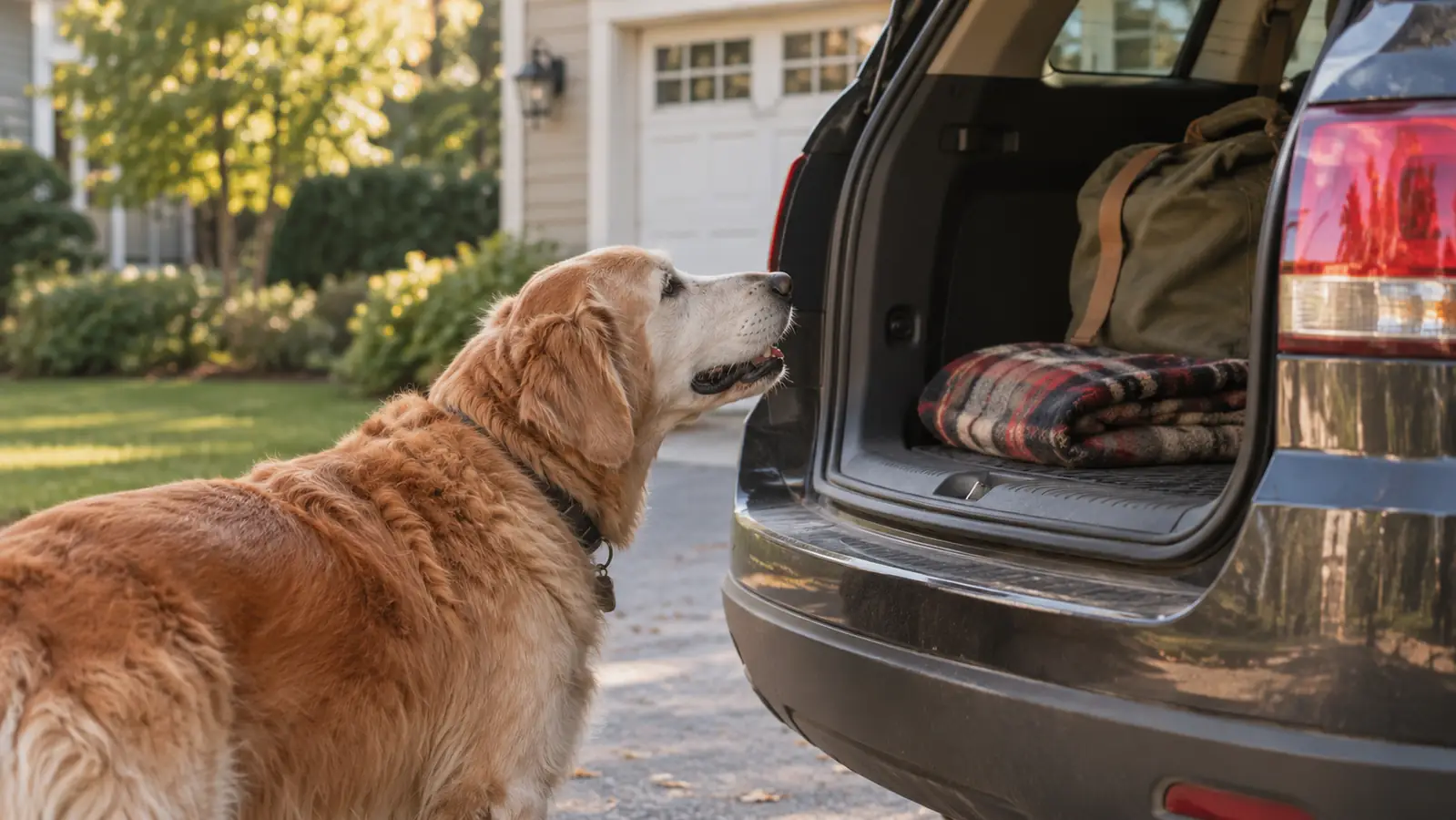
When Biscuit turned eleven, she stopped jumping into the back of our 2019 Subaru Outback. She did not make a fuss about it. She walked up to the bumper, put her front paws on the plastic trim, looked back at me, and waited. Our vet had found arthritis in both her hips and one elbow the year before, so I knew what was happening. Knowing did not make the next few months any easier, and it did not make me any less stubborn about fixing it.
I tried lifting her first. Sixty-eight pounds of Golden Retriever who does not care to be picked up is bad math for a 63-year-old with a sore shoulder, and Biscuit made her opinion known. I tried a step stool, which she refused outright. I tried backing the Outback up to the grassy bank at the end of our street, which worked exactly once and then rained for a week. What finally worked was a PetSafe Happy Ride folding ramp, a bag of freeze-dried beef liver, and about two weeks of short, boring sessions in the driveway. I am not a vet and I am not a trainer. I am just a woman in Boise who worked out the order of operations, including the parts I got wrong.
Below is the sequence that worked. It assumes a dog who is still walking, still willing to eat, and still interested in going places. If your dog has stopped eating or cannot bear weight, close this page and call your vet. That is a different problem than a dog who will not climb into a car.
The ramp that ended the bumper standoff
The PetSafe Happy Ride is a bi-fold plastic ramp, 62 inches long and rated to 150 pounds. It is the piece of equipment that got Biscuit back into the Outback without either of us getting hurt.
Amazon Check Today's Price on Amazon →Before You Start
Three things need to be true before the ramp comes out of the box. Your dog needs to be cleared for light climbing by your vet, because a dog with a spinal issue or a fresh injury is a different conversation than a dog with arthritis. You need a second pair of hands for the first few climbs, at least on the days your dog is unsteady. And you need treats your dog will actually work for. Biscuit will do most things for freeze-dried liver and almost nothing for a dry biscuit.
You also need to accept that this will be slower than you want. I had a picture in my head of Biscuit trotting up the ramp the same afternoon I bought it. The reality was four days of a plastic plank lying flat on my driveway and a dog getting one piece of liver for sniffing it. Two weeks in, she was loading like she had done it her whole life. Two weeks is the honest number.
Step 1: Set the Ramp Up on Flat Ground Before Your Dog Sees It
Unfold it in the driveway or on the kitchen floor while the dog is somewhere else. You want ten quiet minutes with the ramp before you add a nervous animal to the situation. The PetSafe Happy Ride is a bi-fold, so it opens once and lies flat, and it weighs 10 pounds. Ten pounds is light enough for me to carry in one hand and awkward enough that I would not want to be wrestling it on a slope.
Open it and look at what you actually have. Four rubber feet, side rails down both edges, and a walking surface with high-traction treads. There is a safety release latch, and it needs to be exactly where it belongs before anything steps on the ramp. I check that latch every single time, the same way I check that the car is in park. It takes two seconds and it is not optional.
The ramp measures 62 inches long, 16 inches wide, and 4 inches folded. That 62 inches is the number that matters most, because it decides how steep the climb will be. If your vehicle's cargo floor sits high, a 62 inch ramp is still a real hill for a stiff dog. Better to understand that in your own driveway than to discover it in a vet parking lot with a nervous dog and rain coming in.
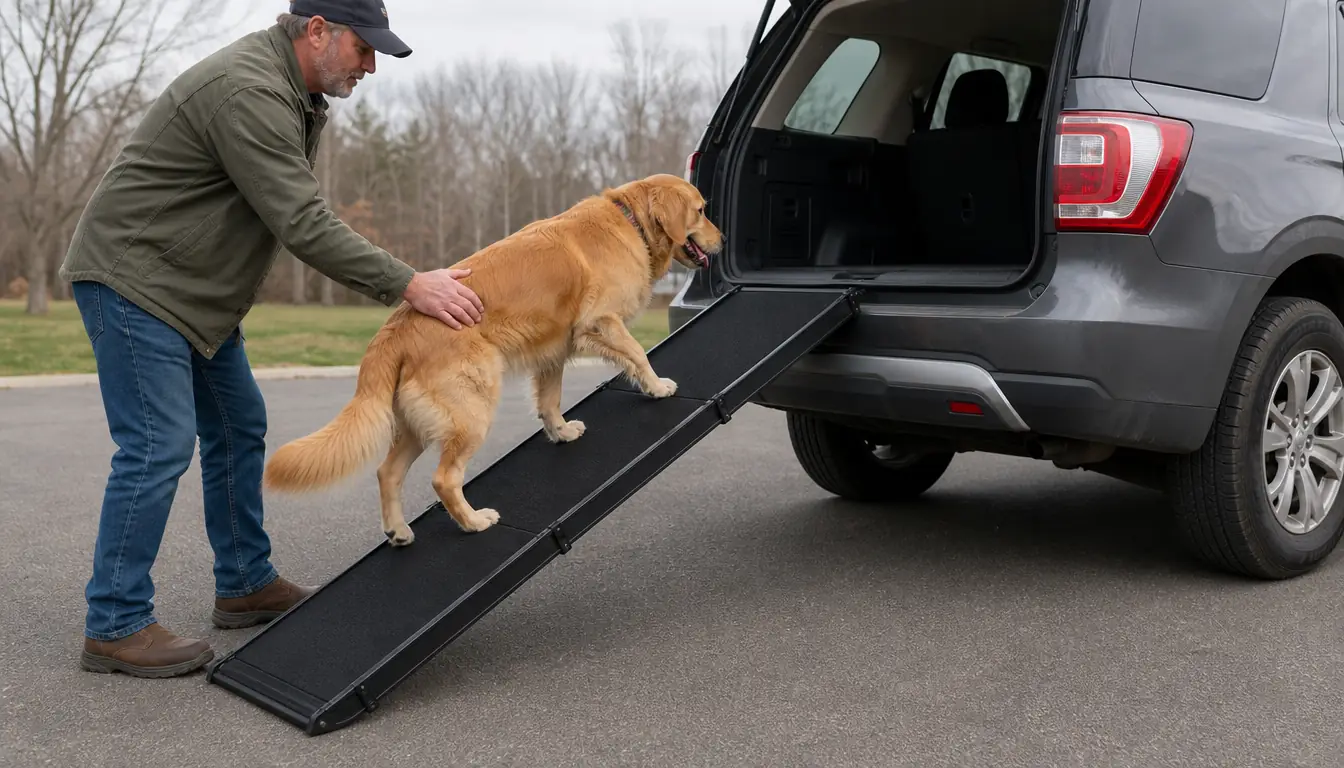
Step 2: Park Where the Ground Is Level and the Ramp Has Room
My first mistake was practicing on our sloped driveway. Biscuit took one look at the angle of that ramp and walked back to the porch, and I do not blame her. Move the car. A flat parking lot, a level street, a driveway with no pitch. Half of what makes a ramp gentle is the ground it is sitting on, and you cannot fix a slope with treats.
Back the Outback up so the hatch opens onto open pavement. You need the full 62 inches of ramp plus a couple of feet of runway behind it, and you need that runway clear. Not the edge of a curb, not a flower bed, not the spot where the trash cans live. The dog should be able to walk onto the ramp from flat ground and walk off it onto the cargo floor without turning sideways.
Then look at the setup again before you bring the dog out. The four rubber feet should be sitting flat on the pavement, not perched on a lip or hanging off an edge. If the ramp shifts when you press on it with your hand, you are not ready. Fix it now. A ramp that moves under a hesitant dog teaches her that the ramp is not trustworthy, and you will spend a week undoing that lesson.
Step 3: Teach It on the Ground, Not on the Vehicle
This is the part I almost skipped, and it is the part that made the difference. For the first four days, the ramp lay flat on the driveway, not attached to the car at all. Just a plastic plank on the ground with liver on it. Day one, Biscuit got a piece of liver for sniffing the end of it. Day one took four minutes and then we went back inside.
Day two was one paw on the ramp. Day three was all four paws, standing there, eating liver like it was her job. Day four was walking the length of it while it lay on the pavement. Nothing about this is fast, and that is the point. Five minutes, twice a day, and then you quit while your dog still thinks the whole thing is a good idea.
The side rails helped more than I expected. Lying on the ground, they give her a clear edge to read, so she knows where the ramp ends without me saying a word. If your dog has trouble with depth perception or is losing vision, that edge matters even more. Keep your hand near the collar and do not pull. Pulling turns a ramp into a thing that happens to your dog instead of a thing she chooses.
Four days on the ground, five minutes at a time, and she walked up a plastic plank in my driveway like it was her own idea. The car was the easy part after that.
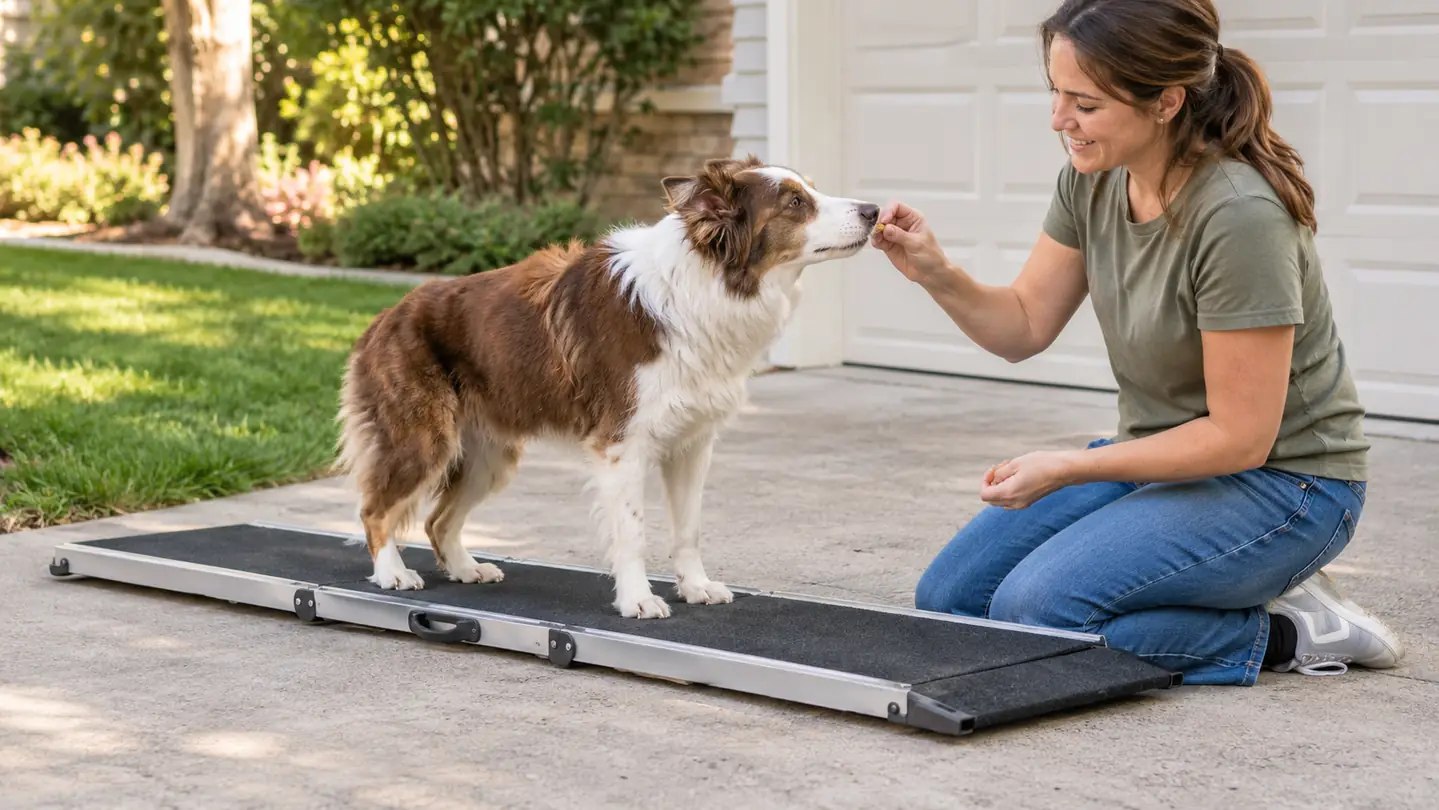
Step 4: The First Real Climb, With the Sling as Backup
Once she would walk the flat ramp without hesitating, I hooked it onto the Outback and we started over from the beginning. Treat at the foot of the ramp. Treat halfway up. Treat on the cargo floor. The first real climb took about forty minutes and a shameful amount of lunch meat, and I did not rush her once. Rushing is how you get a dog who loads once and refuses forever.
I kept the rear-leg sling on her for the first several climbs. The LOOBANI sling goes under her hindquarters and lets me take some of the weight off her back end while she works out her feet on the treads. It does nothing for her front end, and I want to be plain about that. Her elbow got no help at all from the sling. What the sling did was stop her back legs from doing all the work on a surface she did not trust yet.
I stood at her shoulder, not in front of her. Standing in front of a dog on a ramp gives her a reason to stop and lean on you, and then you are holding up a dog on a slope. Standing at her shoulder lets her keep moving forward and lets me steady her hip if she wobbles. If you have a husband in the garage, use him. Two people make the first climbs much less exciting for everyone.
Step 5: Make It Routine, Then Leave It Alone
After about two weeks she was loading without the sling, and after a month she was loading without the treats. That is the goal, and the goal is boring. Now the ramp lives folded in the cargo area, and I can set it up in under a minute in a parking lot. Biscuit walks up, turns around on her blanket, and we go to the park or the vet or wherever the day is taking us.
Two habits are worth building. Wipe the treads if it has rained or if the lot was muddy, because a wet surface is a wet surface no matter how it is made. And check the latch and the rubber feet every single time you open it. The ramp is rated to 150 pounds and Biscuit is 68, so we are well inside the limit, but that only holds when the ramp is set up properly and the feet are flat.
Know when to skip it. On a bad morning, when she is stiff and slow and the parking lot is on a slant, I do not force the ramp. I drive her to the side door at the vet and lift her back end with the sling, or we go home and try again tomorrow. The ramp is a tool, not a rule. A dog who is pushed up a ramp on a bad day remembers it on the next good one.
What Else Helps
The ramp solved the vehicle. It did not solve the arthritis, and I want to be honest about that. Biscuit takes a joint supplement our vet suggested, and she has been on it for about eighteen months. I noticed easier first steps in the morning after roughly six weeks. Not overnight, and not a cure. She still has stiff days. Talk to your vet before you add anything to your dog's routine, because that is a conversation about bloodwork and dosage, not about a blog post.
Two changes at home made a real difference. The first was a proper orthopedic bed in the living room, a large one by the window, which replaced a flat pillow that had given up years earlier. She naps on it in the afternoon and sleeps on it at night, and the cover has been through the wash more times than I can count. The second was traction on the hardwood.
Biscuit wears non-slip socks indoors, put on in the morning and taken off at night. Those socks never go outside. They are for the hallway and the living room floor, and they stopped the little skids that were making her nervous about walking through her own house. A dog who is afraid of slipping walks less, and a dog who walks less gets stiffer. It is a loop, and traction breaks it.
The three wooden steps down to our back deck are still the hardest part of her day. On bad mornings the sling comes off the hook by the back door and I take some of her weight on the way down. That sling is for her back legs only. It will not help a dog whose front legs are the problem, and if your dog's elbows are the issue, ask your vet what to use instead of guessing.
If your dog is standing at the bumper, start on the flat ground
The PetSafe Happy Ride folding ramp is 62 inches long, 10 pounds folded, and rated to 150 pounds. Buy it, then spend a week on the driveway before you spend a minute on the car.
Amazon Check Today's Price on Amazon →