
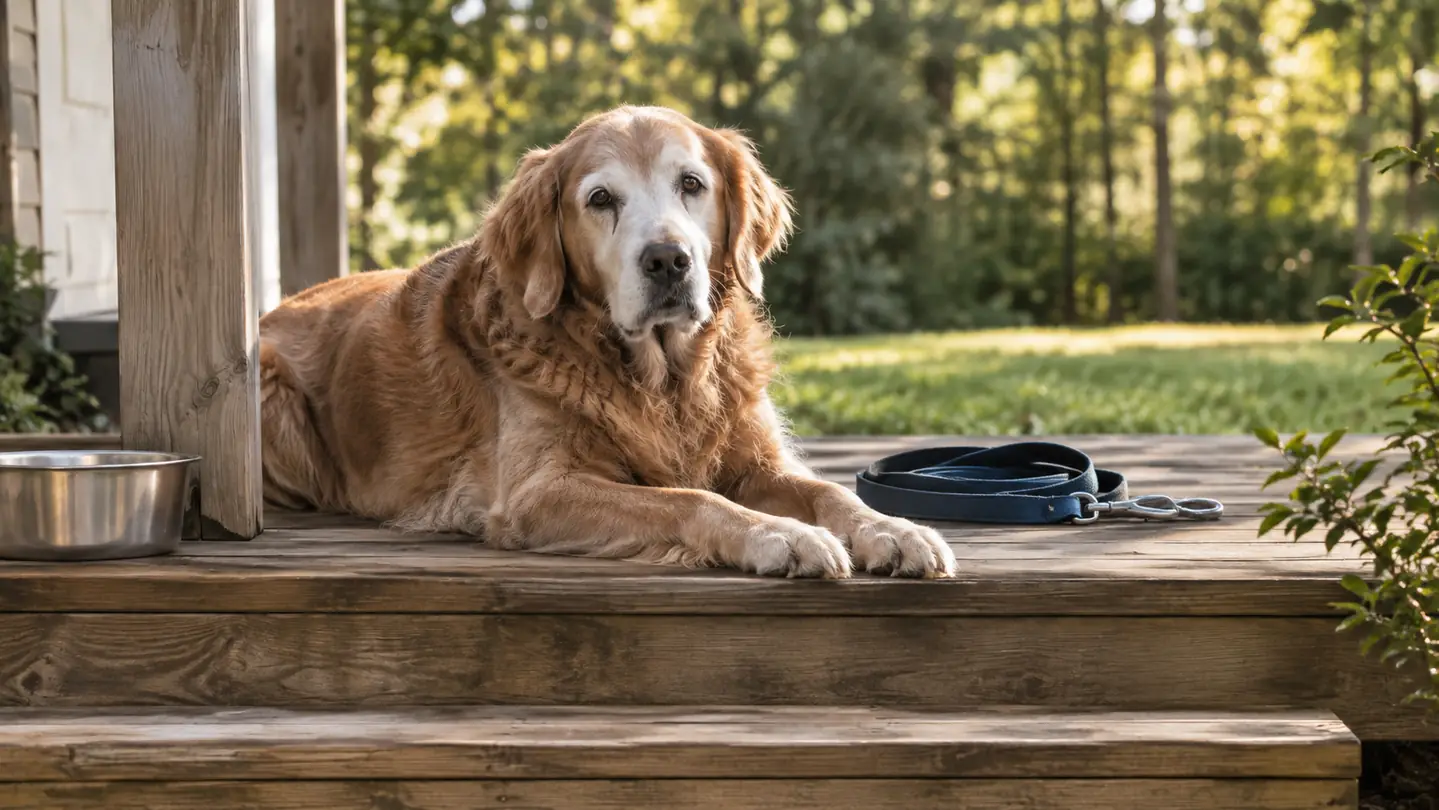
Biscuit is twelve, a 68-pound Golden Retriever, and our vet diagnosed arthritis in her hips and elbows when she was ten. For the first few minutes after she gets up, she moves like the floor is ice. The three wooden steps off our back deck take her one at a time, front feet first, with a pause in the middle. On a bad morning, getting her back end into the 2019 Subaru Outback is a two-person job. I am Ruth Ambrose. My husband Dale and I live in a single-story house in Boise, and I have spent two years figuring out which of the things people sell for stiff old dogs actually change anything.
Here is the short version. The biggest change in our house came from a daily joint supplement, the Cosequin soft chews made by Nutramax Laboratories, given at the same time every morning with breakfast. Our vet suggested it right after the diagnosis. I noticed easier first steps at about the six-week mark, not overnight, and Biscuit still has stiff days. The rest of this is the routine that goes around the chew, because a supplement on its own will not fix a twelve-year-old dog's hips, and neither will a ramp, and neither will anything else. It is all of it together, done in the same order, every day.
The chew that has lived in our pantry for eighteen months
Cosequin soft chews from Nutramax Laboratories, one to two a day as the label directs for a dog Biscuit's weight, given with breakfast. It is a supplement, not a pain pill. It took about six weeks before I trusted what I was seeing.
Amazon Check Today's Price on Amazon →Step 1: Get a diagnosis before you buy a single chew
I nearly skipped this part. I had already decided Biscuit had arthritis, which is a sentence almost every owner of an old dog says at some point. What I did not know was whether the stiffness was arthritis, or a soft tissue problem, or her weight, or something going on in her spine. Our vet did a hands-on exam and x-rays and came back with arthritis in both hips and both elbows. That mattered for two reasons.
First, it told me the problem was structural and was not going to pass, so I stopped waiting and started managing it. Second, it gave me a baseline to compare against later, which is how I know the supplement did something rather than me simply getting used to the way she walked. If I had guessed, I would have been buying chews and hoping, and hoping is not a plan.
I am not a vet and I am not going to diagnose your dog from here. A limp that appears suddenly, a dog who will not put a foot down, or a dog who stops eating is a phone call, not a supplement. Arthritis is slow. Anything fast is usually something else.
Step 2: Match the amount to the dog's actual weight
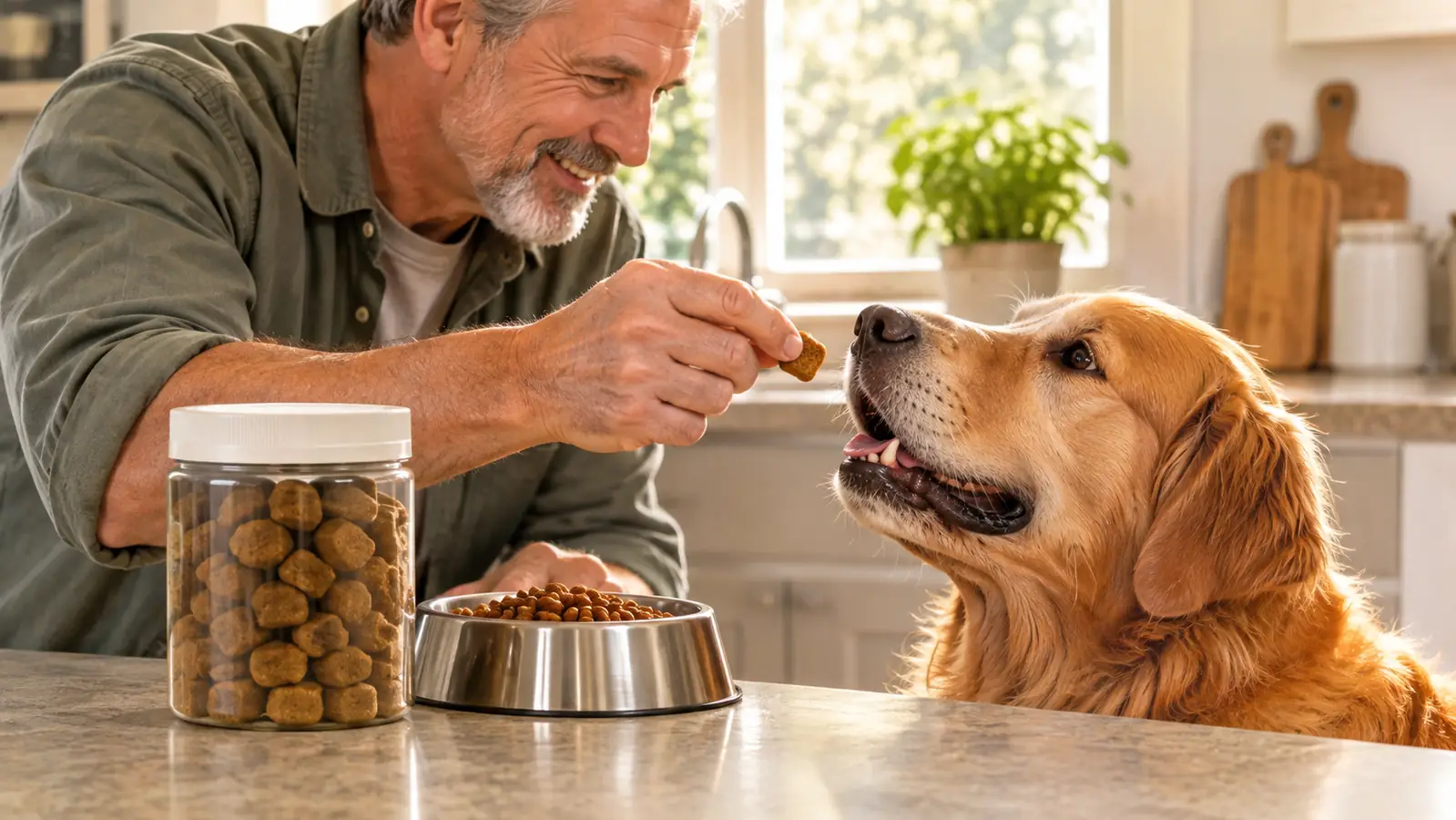
The label gives directions by weight. Biscuit runs about 68 pounds, so she gets one to two soft chews a day as the directions say for a dog her size. I have her weighed at the vet rather than guessing, because a Golden who looks the same size as the neighbor's Lab can be fifteen pounds heavier. The 60-count container from Nutramax Laboratories sits in the pantry next to the flour, and the label is right there on the back if Dale or I lose track of the count.
The mistake I see people make is doubling up on a bad day. That is not how this works. Glucosamine hydrochloride, sodium chondroitin sulfate, and MSM, which are the ingredients listed on the label, are not a pain pill. There is no amount that makes a stiff dog bouncy in an hour. What you want is a steady supply in her system every single day, at the amount the label gives for her weight, no more.
I also stopped stacking products. At one point Biscuit was on three different joint supplements because each one sounded reasonable, and I had no idea what was doing what or whether I was giving her the same ingredient twice. Our vet told me to pick one and stay with it. That was good advice. One product, one amount, one honest opinion about whether it is working.
Step 3: Same time, same meal, and keep it boring
Biscuit gets her chew on top of her kibble at breakfast, before I have had my coffee. That is the entire system. It works because breakfast happens whether or not I remember anything else, and because a dog is a very good alarm clock. She now sits by her bowl at seven and stares at me, which is a better reminder than any note on the refrigerator.
Giving it with food mattered for us too. A soft chew on an empty stomach is fine for some dogs and not for others, and with an older dog I would rather not find out the hard way. The chew is a soft chew with a natural flavor, and Biscuit takes it without coaxing, which was not true of a tablet we tried first.
The point of all this is that consistency is the one active ingredient you control. A supplement given three days a week for two months is a different experiment than one given every day for two months, and only one of them tells you anything useful.
Step 4: Give it six to eight weeks and write down what you see
I kept a spiral notebook on the kitchen counter. Every morning I wrote one line: how long it took her to stand, whether she took the deck steps without the sling, and whether she finished both walks. Nothing fancy. A number and a yes or a no.
The reason is that memory is useless for this. On a good day I was certain the chews were working. On a bad day I was certain I had wasted the money. The notebook showed me the actual shape of it, which was a slow change starting around week six. Her stand-up time went from a long minute to a few seconds. She started going down the deck steps without stopping in the middle. Around week eight she began meeting me at the door again.
Six to eight weeks is the window I would give anything you try. That is roughly how long it took here, and I have heard the same from other owners of old dogs. Anything you quit after four days has not been tested. Anything you keep for six months without a note in a book has not been tested either, you just got used to it.
The notebook is the part nobody sells you. Six weeks in, her stand-up time went from a long minute to a few seconds, and I would not have believed that from memory alone.
Step 5: Fix the floor and the stairs, not just the dog
The chew helped her joints. It did nothing for the slick hardwood in our living room and hallway, which is where I watched her back legs slide out from under her twice in one week. We put down a runner, then bought her non-slip socks, the DOK TigerToes, worn indoors in the morning and taken off at night. She does not love them. She walks like the floor owes her money. But she stops slipping, and for a dog with bad hips, not slipping is worth a little dignity.
The three deck steps got a sling. We use the LOOBANI hind leg support on bad mornings, and only on bad mornings, because I want her using her own legs when she can. It supports the rear end. It does nothing for her elbows or her front legs and I would not tell you otherwise. It hangs on a hook by the back door, so using it is not a decision, it is just there.
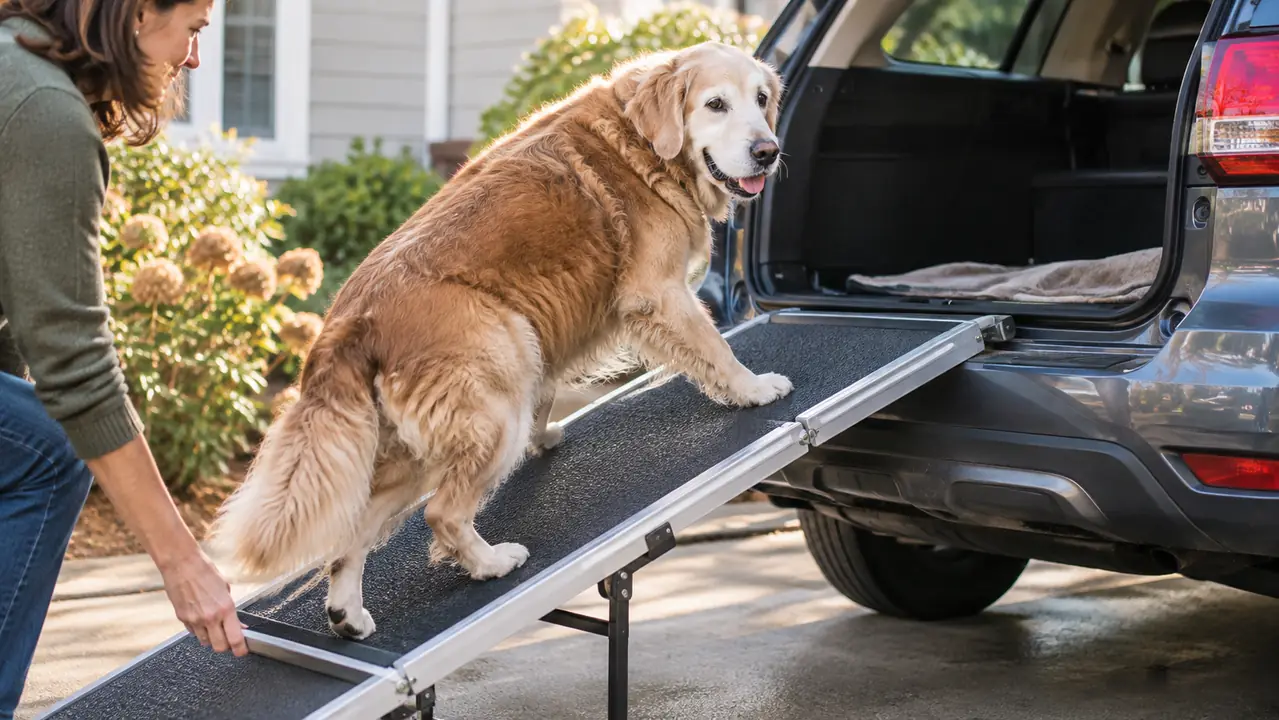
The Outback got a ramp. The PetSafe Happy Ride folding ramp is only for the rear hatch, for vet visits and weekend drives, and it took about two weeks of short sessions with treats before Biscuit would put a paw on it. Now she walks up like she has always done it. It folds and rides in the cargo area. The last piece was a proper orthopedic bed, a large one from Bedsure, because the flat pillow she had been sleeping on was not doing her hips any favors, and the cover needed to survive the washing machine, which it has.
What Else Helps
Weight. Every extra pound on an old dog is another pound her hips carry up the stairs and off the floor. Our vet set a target range and we stay close to it, which mostly means measuring her food instead of eyeballing the scoop.
Short walks, twice a day, on flat ground. Biscuit does fifteen to twenty minutes morning and evening. On a bad day it is ten and slower. The walk keeps the muscle around those joints working, and muscle is what holds a stiff dog together. I used to think rest was kinder. It was not. She got stiffer.
A warm place to sleep and a floor she can grip. That sounds small. It is not small. A dog who is afraid of slipping on the way to her water bowl drinks less, moves less, and stiffens up, and then everything else you are doing has less to work with.
And a vet who sees her twice a year instead of once. Arthritis changes. What worked at ten is not automatically what works at twelve, and there are prescription options that a supplement should never be standing in for. The chews from Nutramax Laboratories were suggested alongside our vet's plan, not instead of it. If your dog is limping badly, or has stopped wanting to walk at all, that is a conversation to have this week, not after you finish a container.
Eighteen months in, Biscuit is not a puppy. She is slow off the floor some mornings, and there are still days when the deck steps are a project. But she meets me at the door, she finishes both walks, and she gets onto the bed by the window in the afternoon without help. That is the whole result. It is not dramatic. It is a dog who is comfortable enough to be a dog, and for a twelve-year-old Golden, that is the thing worth having.
Start with the chew and the notebook, not with a cart full of products
One container, one amount matched to your dog's weight, one line a morning about how she gets up. That is the version of this that actually tells you something in six weeks.
Amazon Check Today's Price on Amazon →