
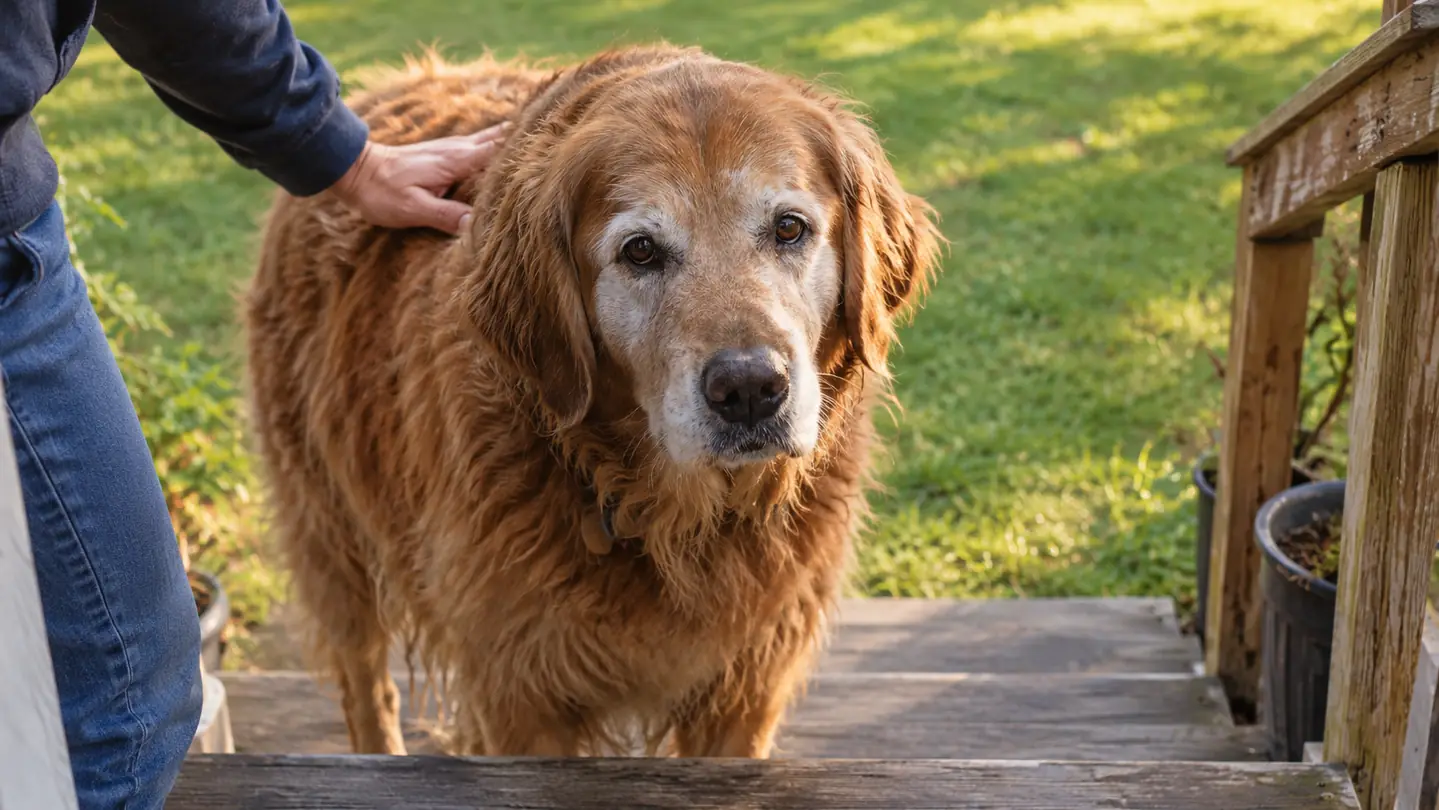
The staircase is three wooden steps from my back door down to the yard. That is the whole thing. Biscuit used to take them at a run, three strides and a scramble and she was on the grass. Now she stands at the top and looks at them the way you look at a curb when your knee is bad. Some mornings she will not start down at all until I come and stand beside her.
Biscuit is a 12-year-old Golden Retriever, about 68 pounds, and our vet diagnosed hip and elbow arthritis when she was 10. I am 63, retired from dental hygiene, and I have a lower back that tells me when I have done something stupid. That combination is why I bought a hind leg sling about ten months ago. The one I use is the LOOBANI adjustable dog sling. I want to be plain about what it did and did not do, because I spent money on two other things first that did not earn their place by the door.
The strap that lives on a hook six inches from the top step
Ten months in, this is the piece of gear I touch every single morning, not just the bad ones. It carries Biscuit's back end down the three deck steps and lifts her into the Outback, and it goes in the washing machine when it gets muddy. Today's price is on the listing.
Amazon Check Today's Price on Amazon →What a Hind Leg Sling Actually Does
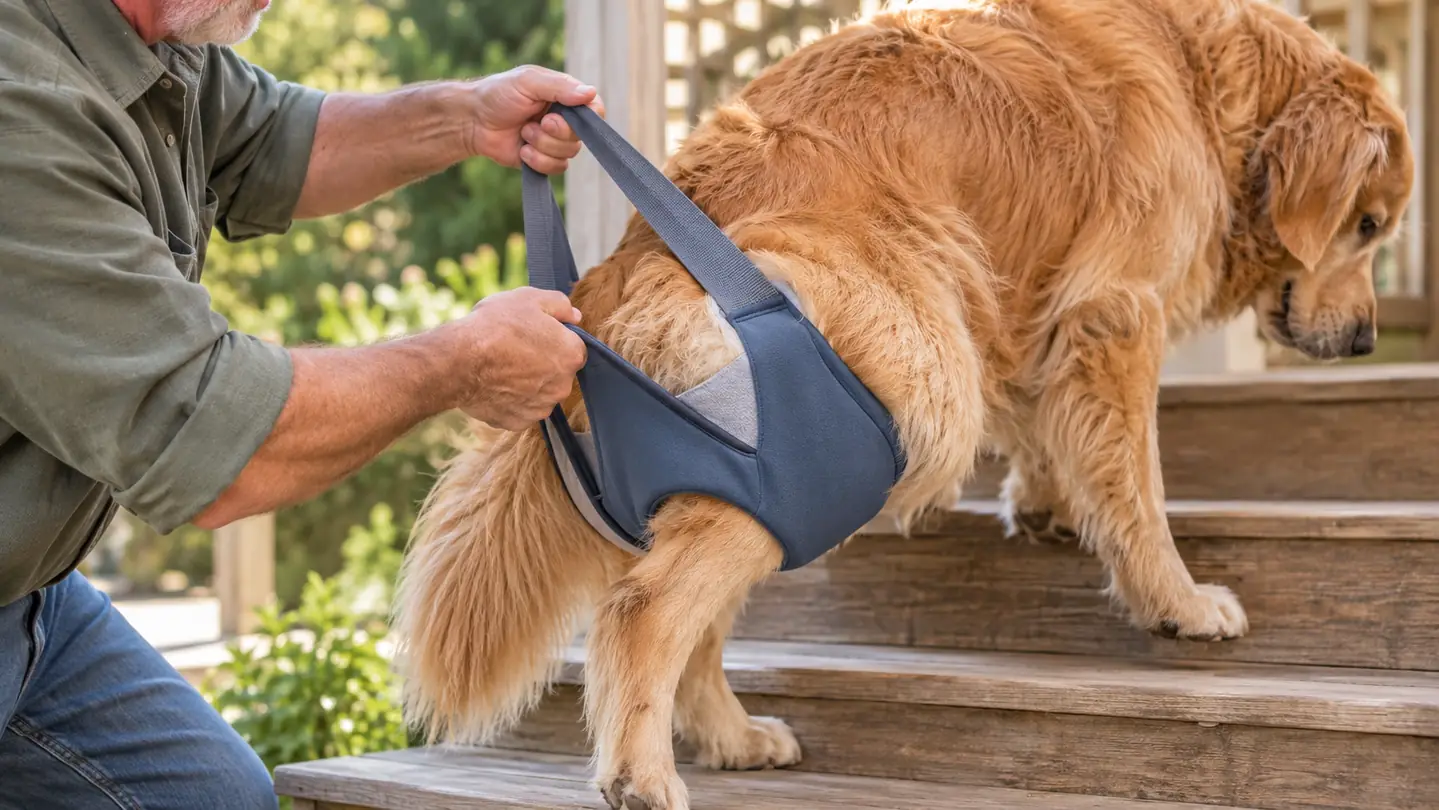
A sling is not a brace and it is not a wheelchair. It is a strap, nylon with a lined section that sits under the dog, plus handles you hold. You are lending the dog your arm for the back half of her body. Biscuit's front legs carry her fine. Her elbows are arthritic, and this sling does nothing at all for her elbows or her front legs. The rear is what quits on the stairs.
So the honest description is this. It does not make arthritis better. It does not strengthen anything. It takes maybe 20 or 30 pounds of a 68 pound dog off her hips for the 30 seconds it takes to get down three steps, so she keeps using the legs she has instead of refusing the stairs altogether. The muscle she keeps, she keeps because she is still using it.
And that is the whole argument for it. A dog that stops doing the stairs stops doing the stairs, and a dog that stops moving gets worse faster. Our vet has said that to me twice, and she was not selling me anything either time.
Step 1: Fit It Before You Go Anywhere Near the Stairs
Take the sling into the living room and fit it on a standing dog with all four feet square on the floor. Not on the stairs, not in the doorway, not while she is lying down and giving you the eye. The first fitting is a two minute job and it should be boring.
The LOOBANI sling in Size Large is listed for dogs roughly 15 to 30 kilograms, and Biscuit sits right at the top of that at 68 pounds. The strap adjusts and the closure is a drawstring, so you can cinch the lined part snug against her underside. What you want is the sling sitting just forward of her hind legs, taking the belly and the top of the back legs, not slung around the middle of her like a shopping bag.
Then check it with your hand. I slide two fingers under the strap. If I can get four in, it is loose enough to slide sideways when she moves and it will end up somewhere useless halfway down the steps. If I cannot get two in, it is digging in. Adjust, walk her across the kitchen, adjust again. It ships with a storage bag, which sounds like a throwaway detail until you are feeling around a dark hallway for the thing.
Step 2: Put It On While She Is Standing, Not While She Is Already Struggling
The mistake I made the first week was putting the sling on Biscuit at the top of the steps, after she had already started to hesitate. By then she is braced and shifting her weight and I am crouched behind her fumbling with a strap, and neither of us is doing our best work.
Put it on before the stairs are in the picture. For us that means the hallway, on the hardwood, first thing in the morning, while she is still deciding whether she wants to go out. She stands. I slide the sling under her from behind and cinch it. Then we walk to the door together.
The order matters for a second reason. A dog that gets the sling put on and then immediately gets lifted will start to brace the moment she sees it. A dog that gets the sling put on and then walks ten feet with it hanging loose learns that it is not a big deal. It took about ten days before Biscuit stopped walking away from me when I picked it up.
Step 3: Take the Steps From the Side and Let Her Set the Pace
Stand beside her, not behind her. If you stand behind and hold the handle, you are pushing her forward, and a dog with bad hips that gets pushed forward will take a step she is not ready for and stumble. From the side you can see her back feet and you can feel what she is doing through the handle.
Let the sling take weight, not the whole dog. That sounds like the same thing. It is not. If I haul upward, her back feet leave the tread and she is a swinging dog. If I take just enough that she feels held, she keeps her feet on the wood and does the work herself. The difference is a couple of inches of handle height. It is the entire difference.
Going down is harder than going up. Everyone assumes the opposite. Up, she pulls against gravity with muscle she still has. Down, she has to control the drop one back leg at a time, and that is exactly what the arthritis has taken from her. So we go down slowly, one tread at a time, and I keep the handle high enough that she has something to lean into. Three steps takes us about 40 seconds now. It used to take four.
Step 4: Work Out a Two-Person Handoff Before You Need It
Dale and I worked this out on a bad morning in February, which is not the time to be inventing a system. Here is what we landed on. Dale takes the handle from behind and I stand at the bottom of the steps with my hand flat under Biscuit's chest, not pulling, just giving her something to walk into. On those mornings she will go down for Dale. She will not go down for me alone.
You do not need two people for three steps every day. You need to know what you will do on the day you do. Decide it in advance. Who takes the handle, who goes in front, where the car is parked, whether the ramp is already out of the back.
One more thing, and I say it as a person with a bad back of her own. A sling moves the weight from your hands to your shoulders, and if you lift with your feet together and your back bent you will feel it by lunch. Feet apart, knees soft, handle close to your body. The strap adjusts, so set it long enough that you can stand up straighter than you think you can.
Step 5: Wash It, Hang It, and Keep It Where You Will Actually Reach For It
The LOOBANI sling is nylon and the care instructions say machine wash. After ten months of Boise mud and dog hair I can tell you it comes out of the machine fine. Ours goes in about once a month on a normal cycle and I hang it to dry rather than putting it through the dryer.
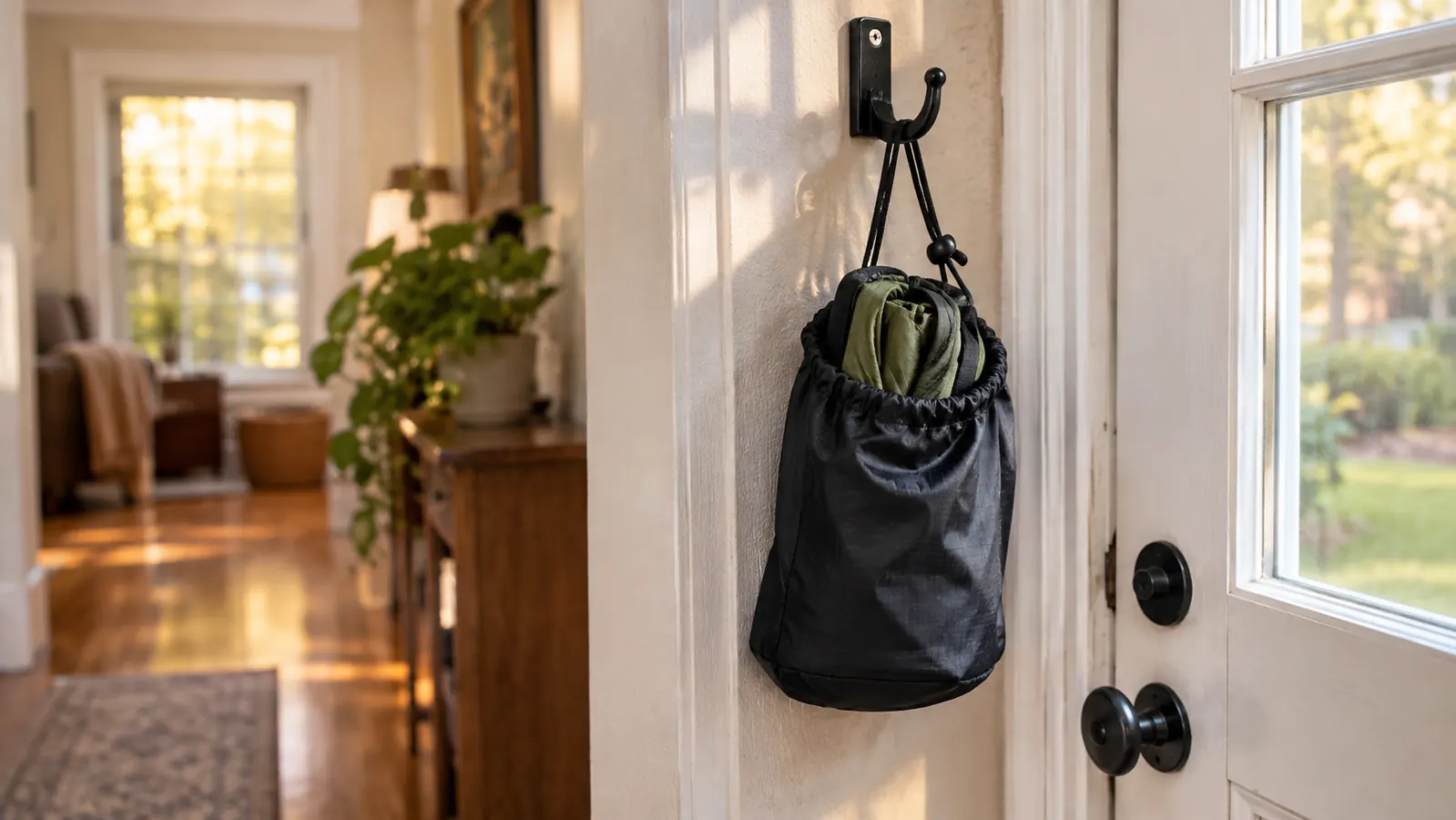
The bigger thing is where it lives. Ours hangs on a hook by the back door, six inches from the top step. That is not tidiness, it is behavior design. If the sling is in a closet I will not go get it for a 20 second trip down three steps, and the three steps are the daily test. It hangs there, I take it down, we go.
Between uses it folds into the storage bag it came with and goes back on the hook. That is the whole system, and it is why I actually use it. It weighs about seven ounces, so on vet days it comes off the hook, goes into the bag, and rides in the Outback's cargo area beside the ramp. Nothing to carry separately, nothing to remember at 8 in the morning.
Ten months in, the sling has not made Biscuit's arthritis better. It has kept her doing the three steps herself, and that is the part I actually care about.
What I Got Wrong the First Month
I lifted too high. For the first week I took the handle and pulled until Biscuit's back feet were clear of the tread, because it looked like helping. What it actually did was take her feet out from under her and teach her to wait for my arm. Lower is better. Barely any lift at all is usually the right amount.
I also used it going up only, because up looked harder to me. Wrong. Down is the direction that frightens her. Now I use it both ways on a bad day and going down on a good one.
And I bought it expecting it to solve the car. It does not, not for us. Getting 68 pounds of stiff Golden into the back of an Outback is a different problem, and I ended up with a folding ramp for that about two months later. The sling is for the three steps, the doorway, the vet's slick floor, and the morning she slipped on wet deck boards.
What Else Helps
Keeping her weight down is the biggest lever and the hardest one, because a 12-year-old Golden who is stiff does not want to move, and a dog that does not move gains weight. Our vet gave us a number at her last check and we weigh Biscuit on the same scale every month. She is 68 pounds. We would like her to stay there.
Traction matters more than I expected. Our living room and hallway are hardwood, and Biscuit was doing a slow split every time she turned around. She wears non-slip socks indoors now, on in the morning, off at night, never outside. The change in her confidence on that floor showed up inside a week.
She has an orthopedic bed in the living room that replaced a flat squashed pillow bed about a year ago, and she uses it more than she uses the couch now. She has been on Cosequin soft chews for roughly 18 months, since the diagnosis, and I noticed easier first steps in the morning after about six weeks. Not overnight. Not a cure. She still has stiff days.
Then the ramp for the Outback, which took about two weeks of short treat sessions before she trusted it. The LOOBANI sling is not a substitute for the ramp and the ramp is not a substitute for the sling. They cover two different parts of the day, and I would buy them in that order again if I had to start over.
When the Sling Is Not the Answer
A sling helps a dog who can still make the movement and needs some of the weight taken off. It does not help a dog who cannot bear weight at all, who is dragging a back foot, who has stopped eating, or who yelps when you put a hand on her hip. Those are vet calls, not gear calls, and I would make them the same day. I am not a vet and I am not going to pretend to be one.
If your dog's back end has changed suddenly rather than slowly, put the sling down and pick up the phone. Slow is arthritis. Sudden is something else.
Start with the fit, not the stairs
If your dog is hesitating at a step she used to take at a run, this is the least expensive way to find out whether a little support changes the picture. Size Large, adjustable, machine washable, storage bag included. Measure your dog against the listed weight range before you order, and check today's price on the listing.
Amazon See the LOOBANI Sling on Amazon →