
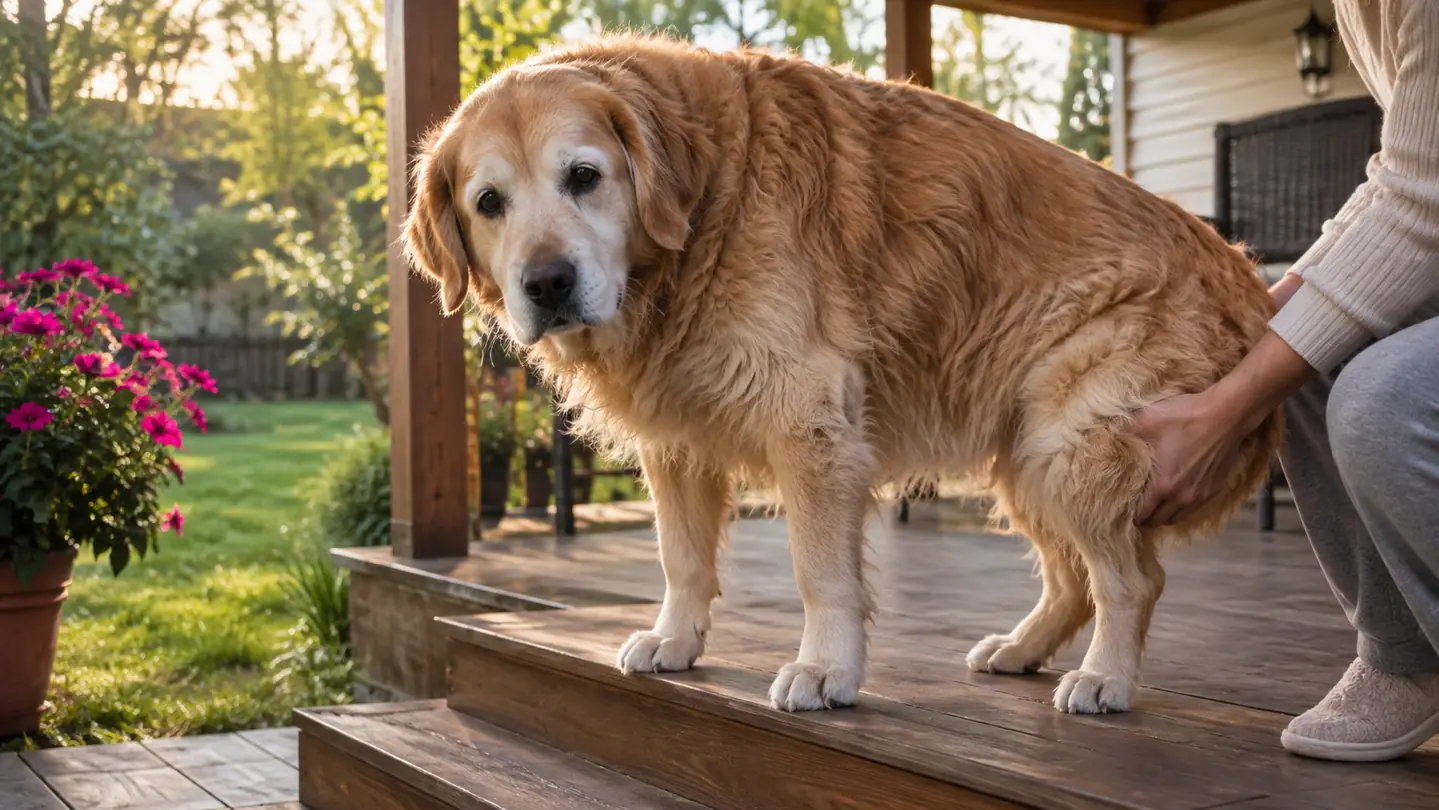
The short answer, if you are standing in a feed store aisle trying to decide: a LOOBANI sling and a full body lift harness are not two versions of the same thing. The sling supports the back end only. A full body harness supports the chest and the back end together. For most big older dogs, the back end is what goes first, and the sling does that job with a lot less fuss. My Golden Retriever, Biscuit, is 12 and 68 pounds, diagnosed with hip and elbow arthritis at 10. I have used the LOOBANI sling on her for about ten months, mostly on the three wooden steps off our back deck and for lifting her into the back of our Outback. I borrowed a neighbor's full body lift harness for a week so I could compare properly. Here is what I found.
One thing before the details. I am a retired dental hygienist, not a veterinarian. Our vet diagnosed Biscuit and I trust her on the shoulder question. If your dog has weakness in the front legs, or a neck problem, ask before you buy anything that wraps the chest. That is not a disclaimer I am tacking on to be safe. It genuinely changes which of these two you should own.
| LOOBANI Sling | Full Body Lift Harness | |
|---|---|---|
| Coverage | Rear legs and hindquarters only | Chest and hindquarters together |
| Front leg help | None. It does nothing for the elbows or the chest | Lifts at the chest, which helps if the front is weak |
| Time to put on | A few seconds, one hand, dog stays standing | A minute or more, several straps, dog has to be positioned |
| Fit and sizing | Adjustable, listed for 15 to 30 kg, one sling for large and extra large breeds | Measured by girth, and between sizes is a hard place to be |
| Stairs and doorways | Lives on a hook by the door, grab it for three steps and go | Enough equipment that a short trip feels like a production |
| Getting into the car | Does the one job it needs to do at the hatch | Works, but more straps than the job requires |
| Cleaning | Nylon, machine wash, folds into the storage bag | More straps and padding to wash and dry |
| Long stretches or all day wear | Not built for it, and it does not pretend to be | Can stay on the dog for longer periods |
| Best for | A dog whose problem is at the back end | A dog who is down in the front and the back |
Where the LOOBANI Sling Wins
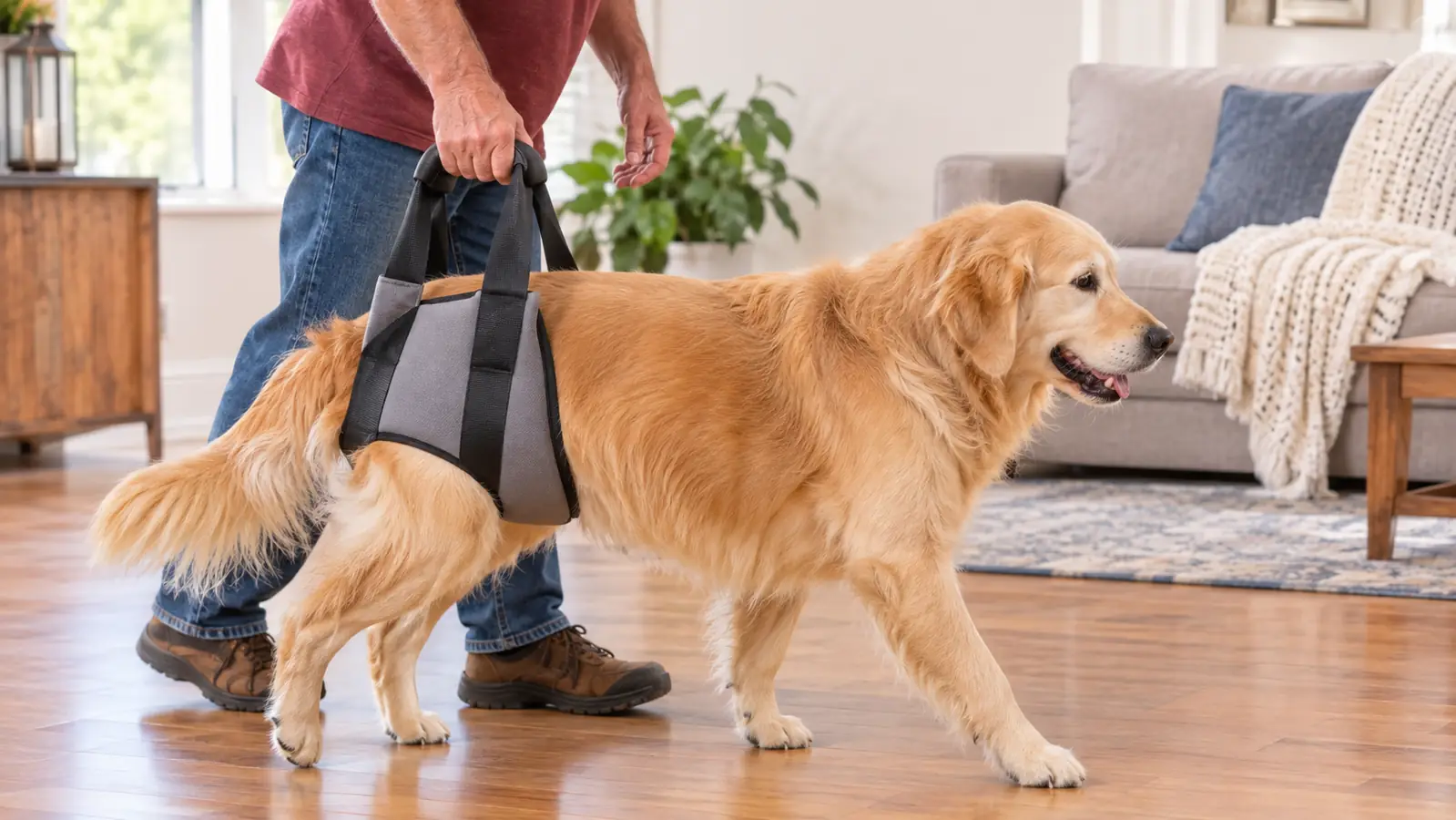
The first thing the sling wins is speed. It hangs on a hook by our back door, and on a bad morning I can have it under Biscuit's hindquarters before she has finished deciding whether she wants to stand. One hand, a few seconds, no straps to sort out. I timed both one Tuesday in February, mostly out of curiosity and partly because Dale did not believe me when I said the harness cost us real minutes. Sling, eleven seconds from the hook to under her belly. Harness, a minute and forty, and that was with a cooperative dog and good light in the kitchen. On a stiff morning, with the dog reluctant and me still in my bathrobe, the harness took closer to three minutes. When you are doing that three or four times a day, the difference is not a small convenience. It is the whole argument.
The second thing is that it stays where you can reach it. The sling folds into the little storage bag it came with, or in our case just hangs by the door, and it weighs next to nothing. I do not have to plan my evening around it. If Biscuit has a wobble at nine at night, I am not wrestling a harness with a handful of buckles onto a tired dog in a dim hallway. The nylon wipes down and goes in the washing machine, which mattered more than I expected with an old dog and a wet Idaho winter.
And the cost of getting it wrong is low. A sling has one adjustment and one job, and the dog tells you within five seconds if it is off. If you misjudge it, you have lost a little money and a few days. A full body harness has to be measured at the girth and fitted around the chest, and if the size is wrong the dog is uncomfortable in the exact place you were trying to help.
Where a Full Body Lift Harness Wins
I want to be fair here, because there is a real reason people buy the harness. If the front end is going too, the sling cannot help. It supports the rear legs, and only the rear legs. I have watched people buy a sling for a dog whose elbows are the bigger problem and then be disappointed in it, and that is not the sling failing. That is the wrong tool for the job. A full body harness gives you a lift point at the chest as well, so you are carrying part of the dog's weight rather than just steadying the back half.
The harness also wins whenever the help is not a three step trip. It can stay on for longer stretches, which means you are not stopping to put equipment on and take it off every time she wants to move between the living room and the kitchen. For a dog who is down and being repositioned several times an hour, that is a genuine advantage and I would not talk anyone out of it. The sling is a tool you pick up for a specific job. The harness is closer to something the dog wears.
If the back end is the only problem, this is the tool that actually gets used
Ten months in, the LOOBANI sling is still on the hook by our back door and still goes on in seconds. It supports the hindquarters, it machine washes, and it folds into its own storage bag.
Amazon Check Today's Price on Amazon →How I Tested Both on Biscuit
I did not run a clinical trial. I did the same things I do every day and paid attention. For one week in March I used the borrowed harness instead of the sling for the deck steps and the car, and I kept a note of how long each took and how Biscuit behaved. The notebook was a steno pad on the kitchen counter with three columns: which tool, how long it took, and one word for how she seemed. Willing, hesitant, or planting her feet and refusing. By Thursday the pattern was hard to miss, because willing showed up four mornings out of five with the sling and once with the harness. She is a patient dog, but she lets you know when something is uncomfortable by leaning her weight away from it. On the steps she was more willing with the sling, and I think that comes down to how much equipment is moving around her back legs while she is trying to decide where to put a foot.
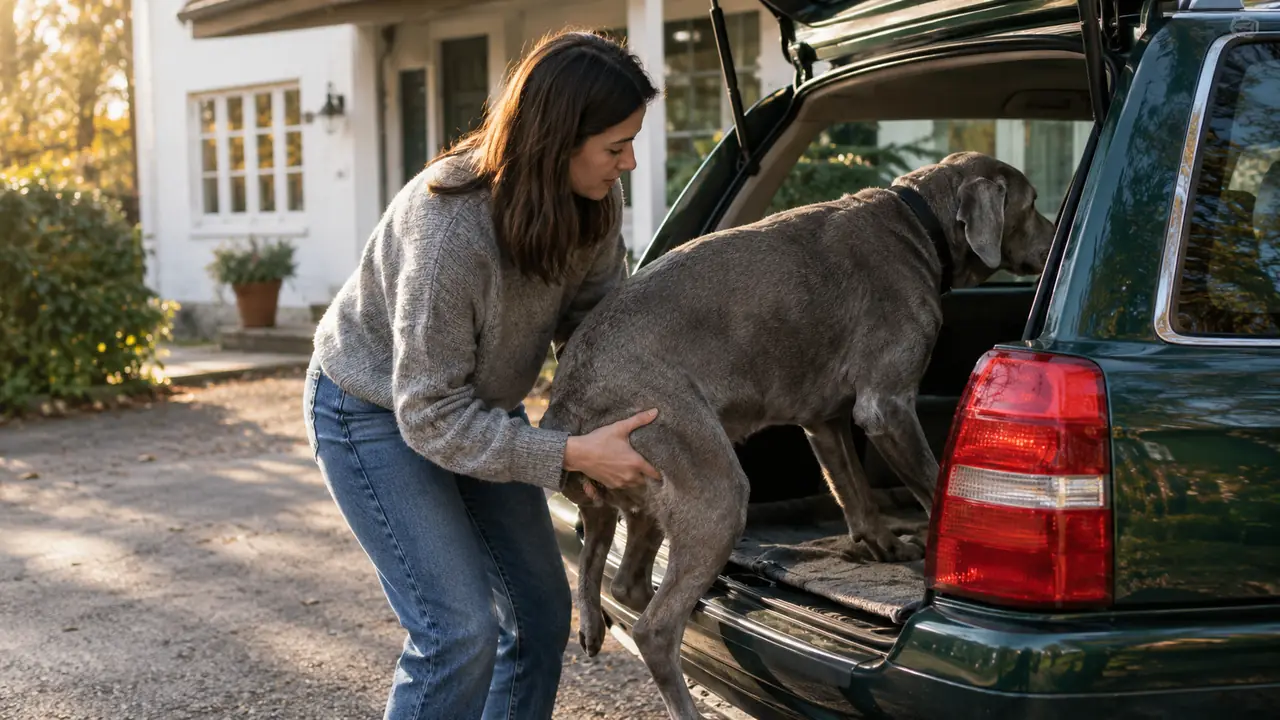
On the car, the difference was smaller than I expected. Both work for lifting a back end into the hatch of an Outback. The harness felt more secure on paper and the sling felt quicker in practice, and quick wins when you are holding a 68 pound dog half upright with one arm and a leash in the other hand. The one place the harness was clearly better was a Saturday when Biscuit was having a rough day and needed help getting up off the living room floor more than once. Taking the sling on and off that many times got old fast.
What the Sling Does and Does Not Do
The LOOBANI sling is a band of nylon with a soft, fleece-like lining that goes under the belly just in front of the hind legs, with a handle above for you to hold. That is the entire design. It steadies the back end and takes some weight off the hips while the dog walks. It does not straighten a leg, it does not replace a ramp, and it does nothing for the elbows or the chest. The listing says it is intended for large and extra large breeds, with a weight range of 15 to 30 kg, and it comes with a storage bag.
The sling does not make Biscuit younger. It makes a bad morning survivable, and that is the entire job I bought it for.
What it does do is give Biscuit enough confidence to use the steps herself instead of standing at the top and looking back at me. That sounds like a small thing. It is not a small thing. A dog that stops using the stairs loses condition quickly, and our vet has been clear that keeping her moving is most of the battle. Ten months in, the sling is the reason she still does the deck steps twice a day instead of me carrying her, which neither of us enjoys and my back enjoys least of all.
The Three Deck Steps Test
Our back deck has three wooden steps down to the yard. Three. Not a flight. You would think three steps would not require equipment, and for eight years they did not. Each riser is about seven inches, which I measured with Dale's tape one afternoon because I wanted to know exactly what I was asking of her. Seven inches is nothing to a healthy two year old Golden. To a 68 pound dog with arthritis in both hips it is a decision she has to make three times going down and three times coming back. Going down is worse than coming up, because she has to trust her back legs to catch her, and that is where the sling earns its place. I hold the handle, take maybe a fifth of her weight, and she does the rest herself.
With the full body harness, the steps worked too, but she was slower and more hesitant. I think that is because there was more going on around her shoulders while she was already thinking hard about her feet. I also noticed I was using the chest lift point more than I needed to, simply because it was there. With the sling there is only one thing to do, and doing one thing well beat doing two things adequately on those three steps.
A Note on Fit and Sizing
The sling is forgiving. It adjusts, it goes under the belly, and if it is a little off the dog walks oddly and you fix it in five seconds. The harness is not forgiving. You measure the girth, you order, and if you land between sizes you are choosing between too tight and too loose, and both are worse than no harness at all on a dog with sore joints. I measured Biscuit twice with a cloth tape and got two numbers half an inch apart, which is all it takes to land on the wrong side of a size chart. Do it standing, do it before she has eaten rather than after, and do it when she is squared up rather than shifted onto one hip, because a dog favoring a sore leg measures differently than a dog standing even. If you go the harness route, measure twice and call the manufacturer if you are unsure. That is not a place to guess.
Who Should Buy Which
Buy the LOOBANI sling if your dog's problem is at the back end: hips, knees, a rear leg injury, or the general stiffness that shows up in a large dog past ten. Buy it if you need help with a specific repeated job, like three steps, a doorway threshold, or the back of a car. Buy it if you want something you can grab with one hand while the leash is in the other. Consider a full body lift harness instead if the front legs are going, if your dog is being repositioned many times a day, or if your vet has told you the shoulders need support. Some people end up owning both, and after this comparison I understand why, though for Biscuit the sling still does everything I actually need it to do.
What I would not do is buy the harness as the first piece of equipment for a dog whose only trouble is the back end. It costs more, it takes longer to put on, and most of what you are paying for is support you are not using. If you are unsure, ask your vet which end is the real problem before you spend anything. That single question decides this for most people.
Start with the simpler tool, then add the other one only if your vet says you need it
The LOOBANI sling is a nylon rear support with a soft fleece-like lining, a handle for the handler, and a storage bag. Machine washable. Ten months of daily use on a stiff 68 pound Golden and it is still the first thing I reach for.
Amazon Check Today's Price on Amazon →