
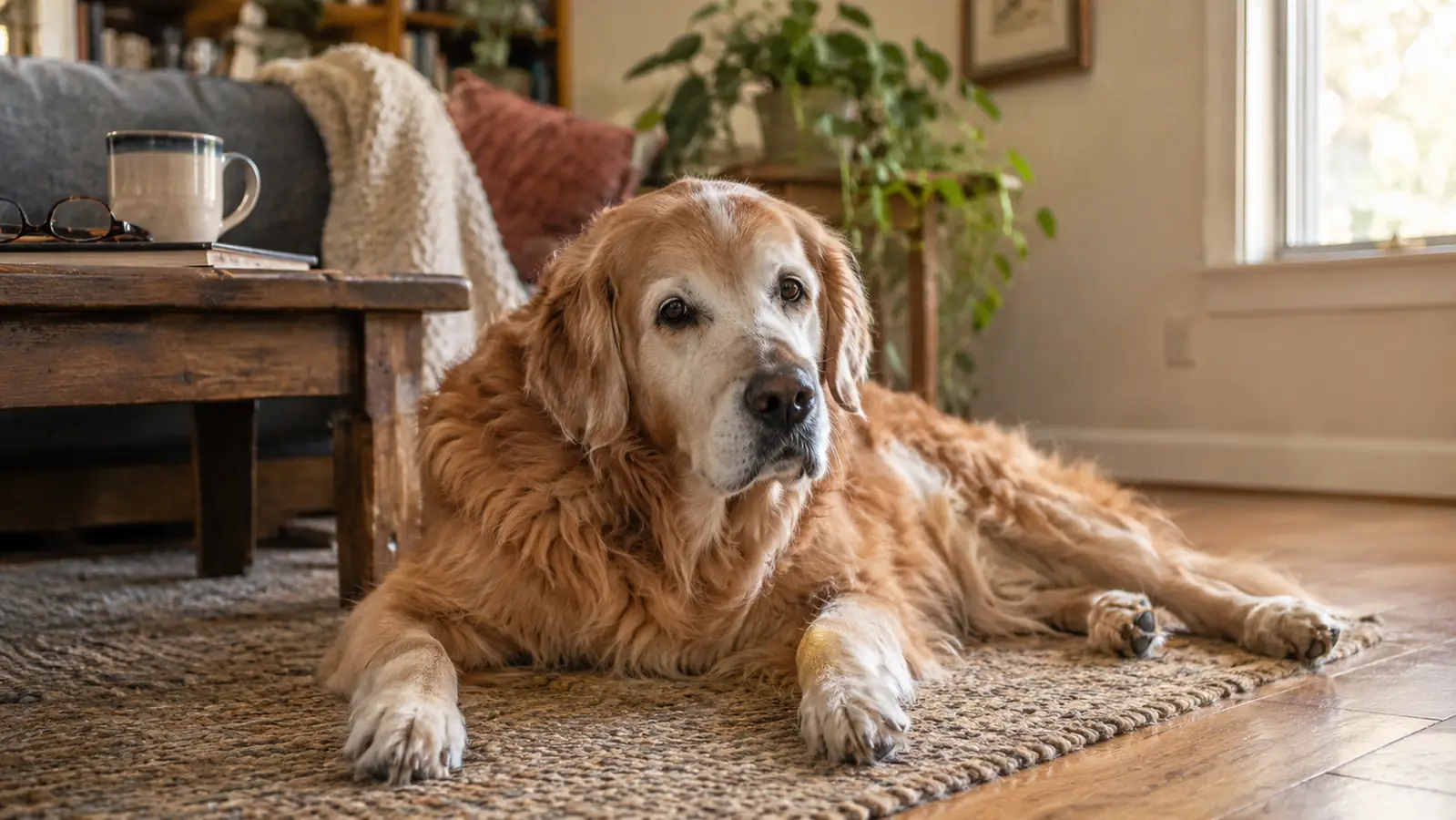
Here is the part nobody puts on the product page. Your dog will have an opinion about wearing socks, and it will not be a quiet one. The first morning I worked a set of DOK TigerToes onto Biscuit's front paws, she stood in the hallway as if all four feet had been nailed to the floor. She did not walk. She did not sit down. She looked back at me over her shoulder with the flat disapproval of a twelve-year-old Golden Retriever who has been patient about a great many things lately and has finally reached her limit.
Six months later, those socks are part of the morning. She plants herself at the end of the hall and waits while I crouch down with them. But the road from that first morning to this one was not straight. It took about three weeks, one round of remeasuring her paws, and a change in how I think about what a sock can and cannot do for an old dog's hips. This is the honest version, including the parts that nearly had me boxing them up and sending them back.
The Quick Verdict
Real traction on hardwood and a strap that holds on a big dog. The sizing is unforgiving and the first three weeks are work, so go in expecting that.
Amazon Check Today's Price →The socks she now waits for at the end of the hall
Size Large fits paws 2.5 to 2.8 inches and four socks come in the pack. Measure the paw while she is standing, then check today's price.
Amazon Check Today's Price on Amazon →What Nobody Tells You Before You Order
The DOK sizing is the whole purchase, and the listing does not say it loudly enough. Size Large is built for paws between 2.5 and 2.8 inches, measured across the widest part of the paw while your dog is standing on it. I put a soft tape on Biscuit's front paw with a piece of cheese under her nose and got 2.7 inches. Large was right. A friend ordered by body weight instead, on the theory that her dog weighs about what Biscuit weighs, and she spent a week fighting a sock that was never going to fit. Measure the paw. Standing. Widest point. That is the whole trick.
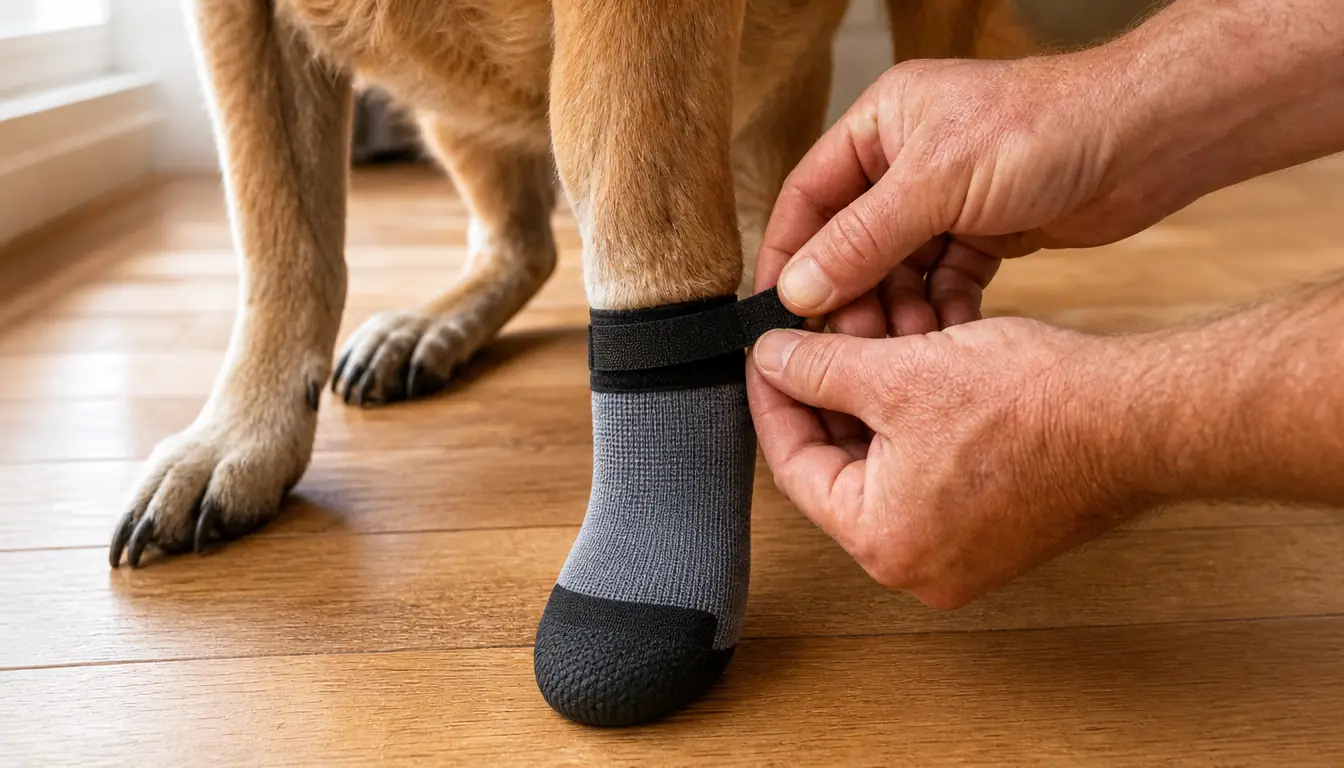
The other thing I did not expect is the strap. These close with a hook and loop band around the ankle, and that band is the reason a 68-pound dog cannot simply back out of them the way she backs out of an old knit sock. The cotton and nylon blend holds its shape through the week instead of going slack. Four socks come in the pack, which matters more than it sounds when one set is on her feet and the other is in the laundry basket and it is seven in the morning.
The listing says the grip keeps working even when the sock twists on the paw. I read that with a raised eyebrow, because claims like that are usually written by somebody who has never watched a dog try to walk in socks. In practice it is closer to true than I expected. Biscuit works hers loose. By mid-morning one sock is usually rotated a quarter turn on the paw. She still has traction. That is not a small thing when the alternative is a front leg sliding out from under her on the living room rug.
How We Use Them, Day to Day
The routine has not changed since the first month. Socks go on after she gets up and has her breakfast, front paws first, back paws too if it is a slow morning. They stay on while she is in the living room and the hallway, which is all hardwood. They come off at bedtime. She has never worn them outside, and I would not, because they are not built for gravel or wet grass and I am not going to be the reason she takes a fall in the yard.
Getting her to accept them took patience I did not know I had. The first week was one sock on one paw for five minutes at a time, with a treat between her front feet. The second week was two socks and a slow walk down the hall on a leash so she could not bolt. By the third week she was doing all four without the leash and the sulking had stopped. Put four DOK socks on a dog who has never worn any and expect her to trot off happily, and you will be disappointed, and you will blame the socks.
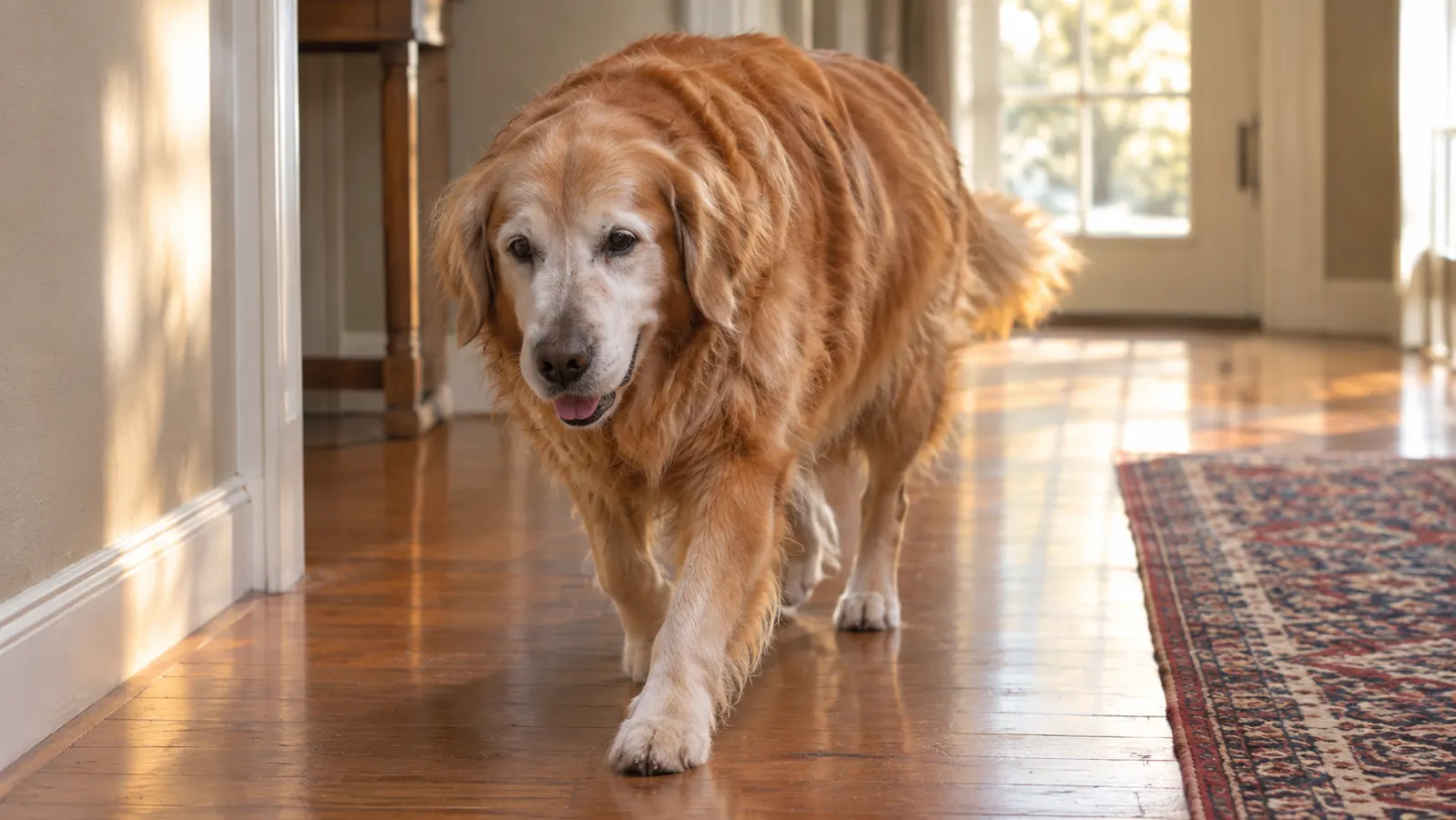
Here is what actually changed in this house once the socks became routine. Biscuit used to hit the hallway at her normal walk and skid on the turn into the rug, front legs splaying, that awful scrambling sound on the wood. Now she crosses the same stretch at the speed she uses on carpet. She gets up from her bed with less of that rocking motion, because her feet are not shooting out in front of her. The socks did not fix her arthritis. They stopped the slipping, and the slipping was making everything else worse.
The socks did not fix her arthritis. They stopped the slipping, and the slipping was making everything else worse.
Where They Help, and Where They Do Not
On hardwood the DOK socks earn their keep, and they help on the bathroom tile too. Where they do nothing at all is the three wooden steps off my back deck, which are the hardest part of Biscuit's day. Those steps are why the sling lives on a hook by the back door. A non-slip sock is an indoor floor solution, not a stairs solution, and I wish that were clearer up front. A reader could easily assume this solves all of it. It solves the flat, smooth, indoor part, and the indoor part happens to be most of Biscuit's day.
I started with the front paws only, because the front legs are where she was splaying. That helped enough that I got lazy about the back. When I finally put all four on, the change in her back end was noticeable, especially on the turn from the hallway into the kitchen, where she used to swing wide and catch herself on the door frame. If you are going to bother at all, use all four. It takes another thirty seconds.
The failure mode is real, though. In the first two weeks one sock came off twice, both times after she had been lying down and then lurched up fast. The strap was snug but not properly seated, and I had not figured out yet that the band needs to sit flat against the fur rather than riding up on the ankle. Once I started doing that, we stopped losing socks. If your dog is a determined chewer, these are not the answer either. Biscuit ignores them. A dog who goes straight for its own feet will make short work of a cotton and nylon sock.
For what it is worth, we tried the simpler version of this first. A long runner rug down the hallway helped and it is still there, and I am not sorry we have it, but it does nothing for the kitchen or the spot in front of her water bowl where she turns around twice before she drinks. That is the argument for socks. They travel with the dog instead of asking the dog to travel on a designated path. If I were starting from nothing, I would buy the socks first and the rug second, and I say that as somebody who owns both.
The Fit Problems Nobody Mentions
Biscuit has a Golden's coat, which means fur grows between her toes and pokes out around the edges of the sock, and the hook and loop band catches it. Not badly, but enough that I keep a small pair of blunt scissors by the door and trim between her pads every few weeks. Nobody mentioned that to me, and it would have saved a few winces.
Four socks on a dog for most of the day means they get damp and they get dog-smelling. They are machine washable according to the listing, and ours have gone through a weekly wash for six months in a mesh bag on a normal cycle. They have held up. The grip has not gone slick, the band still sticks, and the ankles have not gone baggy. I expected to be replacing them by now and I have not had to.
The part I will not pretend away is the labor. Putting four socks on a 68-pound dog twice a day is a chore. On a bad morning, when her hips are sore and she does not want to be handled, I skip the back two and we do front paws only. That is fine. Two socks on a slippery morning beats waiting for a perfect four-sock day that never comes.
Six Months Later, Would I Buy Them Again
Yes, and I already have, for my sister's old dog. What I told her, and what I would tell you, is that this is the simplest fix in this house and the one most likely to end up in a drawer by week two. The deciding factor is not the sock. It is whether you are willing to spend three weeks teaching your dog to tolerate them. If you are, they work. If you are not, put a runner down and save yourself the aggravation.
I gave the DOK socks four stars and not five, for one reason. The sizing is unforgiving and the measuring instructions are not loud enough where you would actually see them. I got lucky with 2.7 inches. My friend did not. Everything else, the grip, the strap, the way they survive the wash, has been better than I expected for something that arrives in a small padded envelope.
I asked our vet about them at Biscuit's last checkup and got the answer I expected. Anything that keeps an arthritic dog from scrambling on a slick floor is worth doing, as long as the dog is not fighting the socks and as long as you are still doing the rest. These are a floor aid, not a treatment. She is still on her Cosequin chews, she still needs the sling on the bad mornings, and she still takes the ramp into the back of the Outback. If your dog has a mobility problem, talk to your vet before you decide socks are the answer to it.
What I would do differently, if I were starting over, is measure twice and buy one pack instead of two. I ordered a second set the first week because I was sure they would be ruined inside a month, and here we are six months later still rotating the original four. I would also start on a weekend, when nobody is rushing out the door and a dog standing frozen in the hallway for ten minutes is funny instead of a problem. Small things, but they decided whether these got used or got buried in the hall closet.
What I Liked
- Grip keeps holding after the sock rotates on the paw, which it does most mornings
- Hook and loop band keeps them on a 68-pound dog who would rather they were not there
- Machine washable, and six months of weekly washing has not flattened the grip or the ankle
- Four to a pack, so one set is on the dog while the other is in the laundry
- Thin enough that she stopped noticing them after about a week
Where It Falls Short
- Sizing is unforgiving. Measure the paw standing and at its widest point, not the dog's weight
- The ankle band catches the long fur between her toes and needs trimming every few weeks
- Indoor use only in practice. They are no help on wet grass or the deck steps
- On and off twice a day is real work, and on sore mornings it is work I skip
- Biscuit still needs the sling on bad mornings. These are not a replacement for that
Six months of weekly washing and the grip has not gone slick
Cotton and nylon, machine washable, hook and loop strap, four to a pack. If the size chart matches your dog's paw, this is the pair I would buy again.
Amazon Check the size chart on Amazon →Who This Is For
This is for the owner of an older dog on hardwood, tile, or laminate who has watched that dog scramble to get up and felt their stomach drop. Biscuit is twelve, sixty-eight pounds, and was diagnosed with arthritis in both hips and both elbows when she was ten. If any of that sounds familiar, you already know the problem is not the walking. It is the slipping, and the flinch that comes afterward, and the way you start steering your dog around your own kitchen.
It is also for the person who has tried the obvious things. We have the orthopedic bed by the window, the ramp for the car, the sling for the deck steps, and the chews in the pantry. Every one of those helps with a different part of the day. The socks are the only thing in this house that touches the fifteen feet of bare hardwood between her bed and her water bowl, and that fifteen feet is where she spends most of her time.
Who Should Skip It
Skip these if your dog's paw falls outside the 2.5 to 2.8 inch range for a Large and you are not willing to measure and possibly exchange. Skip them if your home is wall to wall carpet, because there is nothing for the grip to grip. Skip them if your dog chews at its own feet when it is bored or anxious, because a cotton and nylon sock will lose that argument in about four minutes.
And skip them if the real problem is the stairs or the car. Socks do not help a dog on three wooden deck steps and they do not help a dog get into a hatchback. Those need a sling and a ramp. Being honest about which problem you are actually solving is most of the battle with an old dog, and it took me longer to learn that than I would like to admit.
If your dog scrambles on the floor, start here
Not a cure for arthritis, and not much use on stairs. But on hardwood it is the simplest thing that worked in this house. Measure the paw, give it three weeks, and talk to your vet about the rest.
Amazon Check Today's Price on Amazon →