
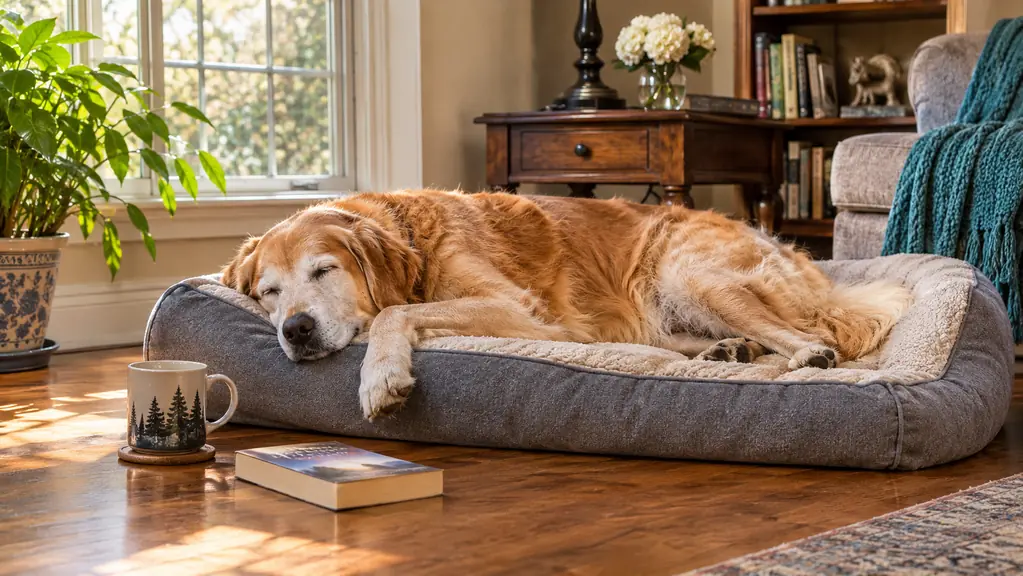
Biscuit is a twelve-year-old Golden Retriever, about 68 pounds, and she was diagnosed with arthritis in both hips and both elbows when she was ten. For the first two years after that diagnosis I did what most people do. I bought beds. Four of them. A flat pillow bed that squashed to nothing under her weight, a cheap donut she circled twice and abandoned, a crib mattress from a garage sale, and one that looked like real furniture and was priced to match. She slept on the hardwood beside every single one of them. What finally worked was a Bedsure orthopedic bed, and the reason it worked had almost nothing to do with marketing and everything to do with four measurements and one label I had been ignoring for two years.
So this is not really a review. It is the checklist I wish someone had handed me three years ago, in the order I would do it if I had to start over tomorrow. It applies whether you end up with a Bedsure bed or something else entirely, and it costs you nothing but an afternoon and a tape measure.
The bed that finally got her off the hardwood
The Bedsure orthopedic bed in Large measures 38 by 28 inches and 6.5 inches thick, with egg foam inside and a cover that comes off for the wash. It is the one that stayed in my living room after four others did not.
Amazon Check Today's Price on Amazon →Step 1: Measure her sprawled out, not curled up
Here is the mistake I made three times. I measured Biscuit standing up, nose to tail, and then bought a bed a few inches longer than that number. It sounds sensible. It is not. A dog with sore hips does not sleep standing up, and she does not sleep curled in a tight ball the way she did at four. She stretches out. Front legs forward, back legs out to one side, and the whole operation takes about a foot more length than her standing body does.
So get her on the floor and wait for her to fall asleep, then measure the sprawl. Tip of the front paw to the tip of the back paw, and side to side across the widest point, which for Biscuit is where her back legs splay out. Add two inches to each number. That is your minimum.
For Biscuit that came out to roughly 36 by 27 inches. The Bedsure Large is 38 inches long and 28 inches wide, so it clears her sprawl with a little room to spare. If your dog is bigger than 70 pounds, or sprawls wider than she does, measure again before you buy. A bed she has to fold herself into is a bed she gets off of at two in the morning.
One more thing about size. A 38 by 28 bed takes up real floor. Ours sits against the wall by the window with about a foot of clearance on the open side, so she can walk up to it and turn around without stepping on the hallway rug. If you are squeezing a bed into a corner with no room to circle, she will use it less than you expect, no matter how good the foam is.
Step 2: Read the foam, not the word on the box
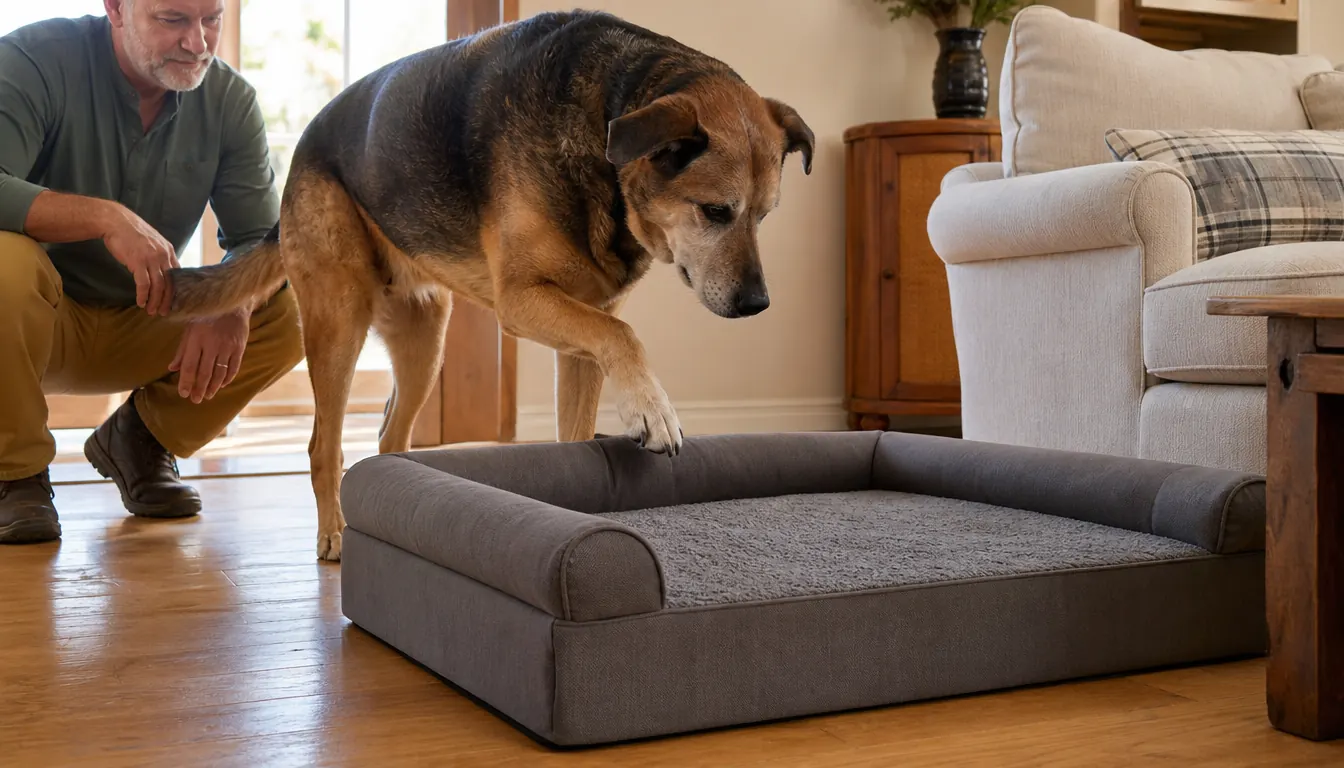
The word orthopedic is not regulated. Anybody can print it on a bag of polyester fluff. What matters is what is under the cover. You want a dense foam base, one that pushes back when you press your palm into it and recovers its shape. Not a bag of loose fill that parts around your hand and stays parted.
The Bedsure bed uses egg foam, which is polyurethane foam molded with a bumpy top surface. The bumps do two jobs. They let air move under the dog so she is not lying in her own heat, and they spread her weight across a lot of small contact points instead of three or four big ones. On a 68-pound Golden with sore elbows, that difference shows up in how long she stays put.
Two certifications are worth looking for because they are checkable rather than decorative. CertiPUR-US covers the foam. OEKO-TEX Standard 100 covers the fabric and what is left in it. The Bedsure listing carries both. That is not a reason on its own to buy a bed, but it is a reason to cross off the ones that cannot tell you what is inside theirs.
Here is a test you can do with your hand in ten seconds. Press your palm flat into the middle of the bed and hold it there for a count of five. When you lift your hand, the foam should come back up. If you can feel the floor through it, it will do nothing for a sore hip. If your hand sinks in and the dent stays, it will flatten out under a 70-pound dog in a month. Somewhere between those two is what you want.
Step 3: Read the cover like you are the one doing the laundry
Senior dogs have accidents. There, I said it. Biscuit has had maybe six in the last two years, and every one of them landed on a bed. A bed that cannot be washed is a bed that goes to the curb. So before anything else, find the zipper.
The cover on the Bedsure bed comes off. It is waterproof underneath, which means a spill does not soak into the egg foam and sit there quietly turning into a smell. I have run that cover through my washer more times than I can count over the past year and it has not shrunk, torn at the seams, or lost its shape. The foam itself I spot clean and air out on the deck, never in the machine. That is the routine: cover in the wash, foam in the shade, back together before bedtime. If a bed you are looking at does not have a removable cover, put it back on the shelf.
I keep a spare cover in the closet, which sounds fussy until the first time you need it at nine at night. It also means the bed goes back into service the same evening instead of waiting on a laundry cycle. If a bed you are considering sells covers separately, ask yourself whether that is a convenience or a warning sign.
Step 4: Watch how she gets up, then look at the edges
Watch your dog get up off the floor. Not once. Three or four times, on a bad morning. Biscuit bunches her back legs under her, pushes with the front end, and needs something solid to push against. A bed that is all soft edge gives her nothing and she ends up scrabbling.
The Bedsure bed has bolsters on all four sides, and the whole thing is 6.5 inches thick, so those bolsters are a low wall rather than a nest. For Biscuit that is exactly right. Enough of an edge for her to brace a front paw against when she is pushing up, and something to tuck her nose against when she is settling. A dog that is weaker in the front end may need less of a wall. Get down on the floor and compare that thickness to your own ankle before you decide.
There is a version of this that goes the other way, too. A dog with very weak back legs can get stuck behind a high bolster and be nervous of the bed afterward. If your dog is at that stage, look for a low profile on at least one side, or fold a blanket over the bolster for the first week so she can walk over it. You can always take the blanket away later.
Step 5: Put it where she already lands, then leave it alone for two weeks
A new bed in a new spot is a new thing to be suspicious of. A new bed in the spot where she already naps is just her spot, with better padding. Watch her for two or three days first and note where she actually lands. For Biscuit it was a patch of sun by the living room window from about one in the afternoon until supper, and the same corner at night.
That is where the Bedsure bed went, and I did not move it for a month. The first two days she stepped on it, stepped off it, and lay on the hardwood beside it, which is a special kind of insult after you have spent an afternoon measuring. On the third day she got on and stayed for an hour. By the end of two weeks she was going to it on her own after the evening walk. Give it that long. Do not wash it with a strong detergent the first week, do not move it, and do not make a fuss over her when she uses it.
The other thing I got wrong early on was treating the bed like furniture, which is to say I kept it off the floor and out of the way. A dog bed that lives in a corner nobody sits in is a dog bed nobody uses. Hers is in the middle of the living room, in the way, and that is exactly why it works.
Three days of suspicion, then an hour asleep. Two weeks after that she was walking to it on her own after the evening walk, which is the only test of a dog bed that has ever mattered to me.
What Else Helps
A bed is the floor half of the problem. Biscuit's sore hips did not get better because of a bed. They got easier to manage because of a handful of small things pointing the same direction, which is less strain on the joints and less slipping.
Traction comes first, because our house is mostly hardwood and a dog that slides is a dog that tenses. She wears non-slip socks indoors, on in the morning, off at night, and never outside. You can also just put a couple of cheap runner rugs down on the path she uses most, which is what I did in the hallway before I found the socks.
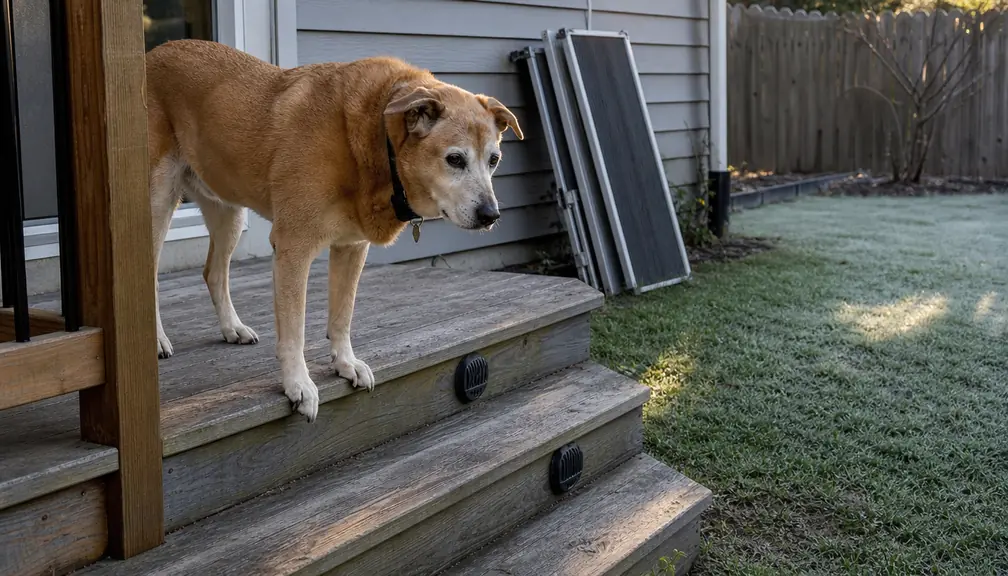
The three wooden steps down to the back deck were the next thing. Biscuit takes them slowly and on bad mornings she needs help, so there is a sling on a hook by the back door. It supports her back end, and it is only for the back end. It does nothing for her elbows and I would not pretend otherwise.
For the car, the Outback's hatch is high enough that she will not jump in anymore. A folding ramp lives in the cargo area, and it took about two weeks of short sessions with a treat at the top before she trusted it. Walks stayed short, fifteen to twenty minutes twice a day, on the flat. She has also been on Cosequin soft chews since the diagnosis, on our vet's suggestion, and that is a conversation for you and your vet rather than for me.
The last thing, and I say it gently because it was hard for me. Biscuit was 74 pounds at her worst and she is 68 now, and those six pounds made more difference to her first steps in the morning than any single thing I bought. Our vet set the target and we got there with smaller portions and the same two short walks. If your dog is carrying extra weight on arthritic hips, the bed helps her rest and the weight loss helps her move, and you want both.
None of this is treatment. It is management, and it is what our vet and I worked out together over about a year. If your dog is limping, or favoring a leg, or has stopped wanting to go on the walks she used to pull you toward, that is a vet conversation before it is a shopping conversation.
Start with the floor, then work outward
The Bedsure orthopedic bed in Large is 38 by 28 inches, 6.5 inches thick, with egg foam inside, a waterproof layer under a removable cover, and a year of a 68-pound Golden and my washing machine behind it.
Amazon Check Today's Price on Amazon →