
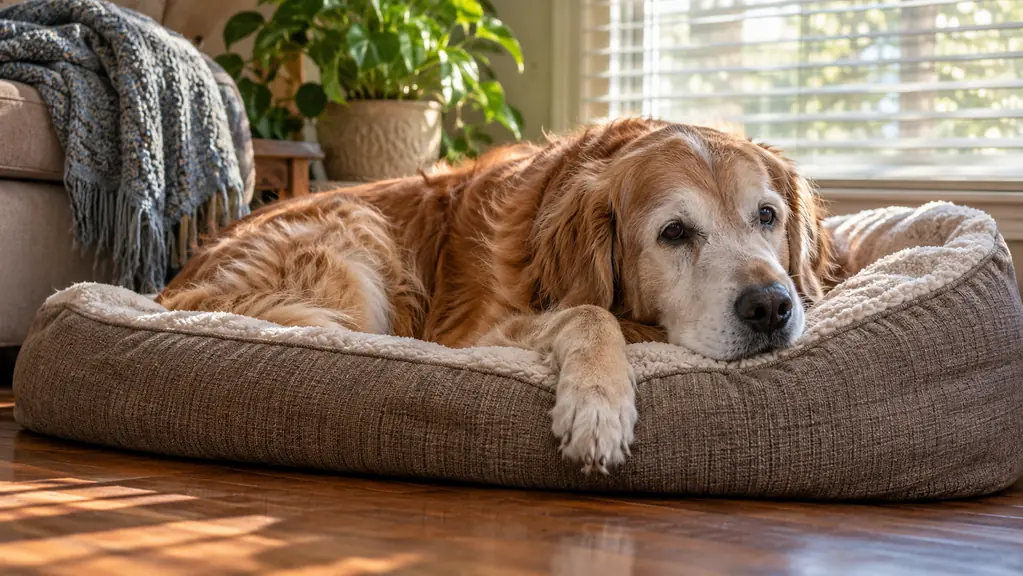
I have had the Bedsure orthopedic dog bed in my living room for about a year now. Biscuit, my twelve-year-old Golden Retriever, sleeps on it every night and naps on it most afternoons, and the cover has been through my washing machine more times than I can count. So this is not a first-impression review. It is the version I wish somebody had handed me before I spent a whole evening reading reviews and still could not tell whether the thing would hold up under a sixty-eight pound dog with arthritis in both hips and both elbows. Here is what a year actually looked like.
The short version: it helped. It did not fix anything, and there are two or three small things about it that irritate me every week. Both of those statements are true at once, and most reviews only give you one of them. If you are looking for the story where a bed cures a dog's arthritis, this is not that article. If you want to know what the foam does by month four and whether the cover survives a stomach bug, keep reading.
The Quick Verdict
A thick foam bed that genuinely helps a big stiff dog get up off hardwood, with a washable cover that earns its keep. The foam softens by month four and the bolsters go first. Worth it, with honest expectations.
Amazon Check Today's Price →If your dog's back legs skate when she first stands up, this is where I would start
This is the bed Biscuit has slept on for a year. I bought the Large, 38 by 28 inches, for a 68 pound Golden. Measure your dog nose to tail before you order, because a sprawler will hang over the edge.
Amazon Check Today's Price on Amazon →How I've Used It
Biscuit was diagnosed with hip and elbow arthritis when she was ten. Our vet was straightforward about it: manage her weight, keep her moving, keep her comfortable, and expect stiff days. Our house is mostly hardwood, which is fine for a young dog and miserable for an old one. She would get up off the floor and her back legs would skate a little before she found traction, and I could hear her nails scrabbling from the next room. That sound is why I started looking.
The bed she had before was a flat pillow style. It looked generous in the photo and went flat as a pancake in about four months. I could fold it in half with one hand and feel the floor right through it. That is how we ended up shopping for something with actual foam in it instead of stuffing.
I was not shopping for a pretty bed. I was shopping for a surface that would keep her body off the hardwood for eight hours a night. The Bedsure bed was one of the few in the size I needed that listed a foam fill and a removable cover, and there were enough reviews that I could read the bad ones and learn something from them. That mattered more to me than the star average, which tells you almost nothing on its own.
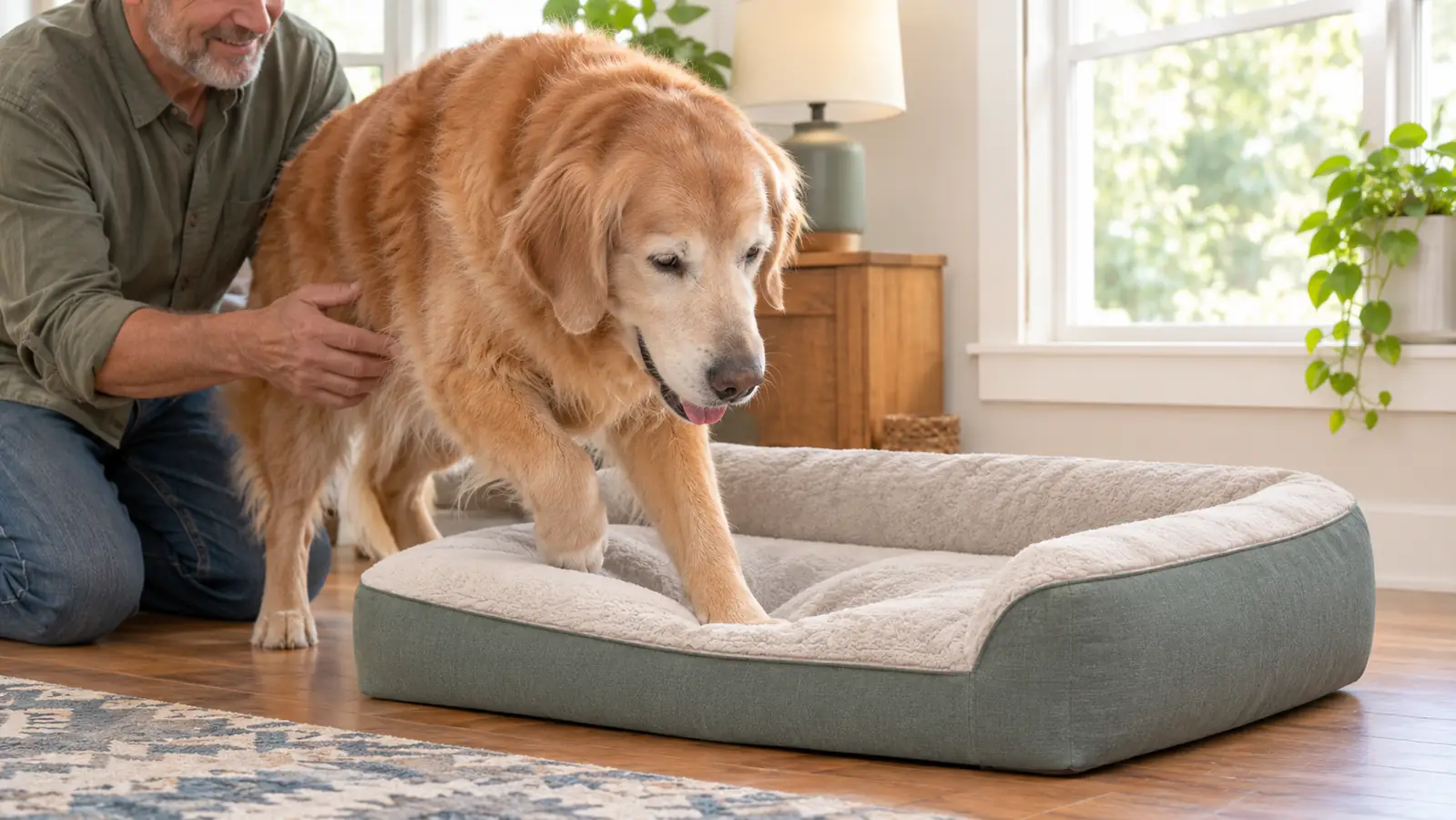
It arrived rolled and compressed. I let it sit for a day before I put it on the floor, and by then it had come up to its full thickness. Biscuit walked over, sniffed it, and got on before I finished telling her to. That is not a trained behavior. She is a dog who knows a soft surface when she smells one, and she had been sleeping on the equivalent of a folded blanket.
It has lived by the living room window ever since. She naps on it in the afternoon when the sun comes through, she sleeps on it at night, and she gets off it for her two short walks a day, morning and evening, fifteen or twenty minutes each. That is the entire test protocol. One real dog, one real house with three wooden steps down to the yard, and a year of ordinary use.
What Nobody Tells You About the Word Orthopedic
In the pet bed aisle, orthopedic mostly means the bed is thick and made of foam instead of loose polyester fill. It is not a medical device, nobody regulates the word, and a cheap bed and an expensive bed can both print it on the box. I am not a veterinarian and I am not going to pretend the label means more than it does. I am a retired dental hygienist with a stiff dog and a hardwood floor.
What actually matters is thickness, what kind of foam it is, and whether the whole thing bottoms out when your dog lies down. This bed is listed at 6.5 inches thick, with egg-crate foam inside a removable cover, and the foam is polyurethane certified through the CertiPUR-US program. Six and a half inches sounds like a mattress and is not one. Under Biscuit's sixty-eight pounds it compresses to maybe two inches beneath her hip.
That is fine, by the way. Two inches of foam between an arthritic hip and a hardwood floor is a different life than a quarter inch of flattened polyester. I am only giving you the number so you do not order it expecting a mattress. The correct comparison is not a mattress. It is the squashed pillow bed your dog is lying on right now.
When I asked our vet whether a bed mattered at all, she said comfort is part of management. She did not tell me it would change the x-rays. She said a dog that sleeps badly moves worse the next day, and a dog that moves worse gets stiffer, and that loop is worth interrupting. A bed is one plain way to interrupt it. Our vet has never seen this bed and has no opinion on the brand.
One listing detail confused me enough that I want to flag it. The product page carries a maximum weight recommendation of fifteen pounds, which I can only read as a data entry error on a bed sold as Large and photographed with big dogs on it. I ignored it, and the bed has been fine under a sixty-eight pound dog for a year. But if you see that number and hesitate, that is probably why.
What I Liked
- 6.5 inches of egg-crate foam keeps a 68 pound dog off the hardwood
- Cover zips off and has survived roughly a dozen washes without losing shape
- Waterproof backing has held up, including through one stomach bug
- Light enough at 6.77 pounds to drag across the room one handed
- No chemical smell out of the box, which I cannot say for every foam item I have bought
Where It Falls Short
- The foam flattens where the dog sleeps by around month four
- The bolsters lose loft before the base does
- It slides a couple of inches on hardwood when a dog launches off it
- A dog that sprawls flat will hang over the 38 by 28 inch surface
- The word orthopedic is doing far less work than you probably think
The Foam Softens, and That Is Normal
Somewhere around month four I noticed the egg-crate surface had flattened where she sleeps. Not a hole, not a sag you could see from across the room, just less loft in the exact spot where sixty-eight pounds lands every single night. I unzipped the cover on the Bedsure bed, turned the foam over, and got a few more months of spring out of it. I do that maybe twice a year now and I consider it routine maintenance, the same way I rotate the mattress in the spare room.
If you want a bed that feels factory new in year three, this is not that bed and I would not promise otherwise. I expected a year of decent sleep out of it and I got a year of decent sleep out of it, and when the foam finally gives I will replace the whole thing rather than hunt for a replacement insert. What I would tell a neighbor is this: buy it knowing the foam is the wear part, the way the sole is the wear part on a shoe.
The Cover Does Most of the Work
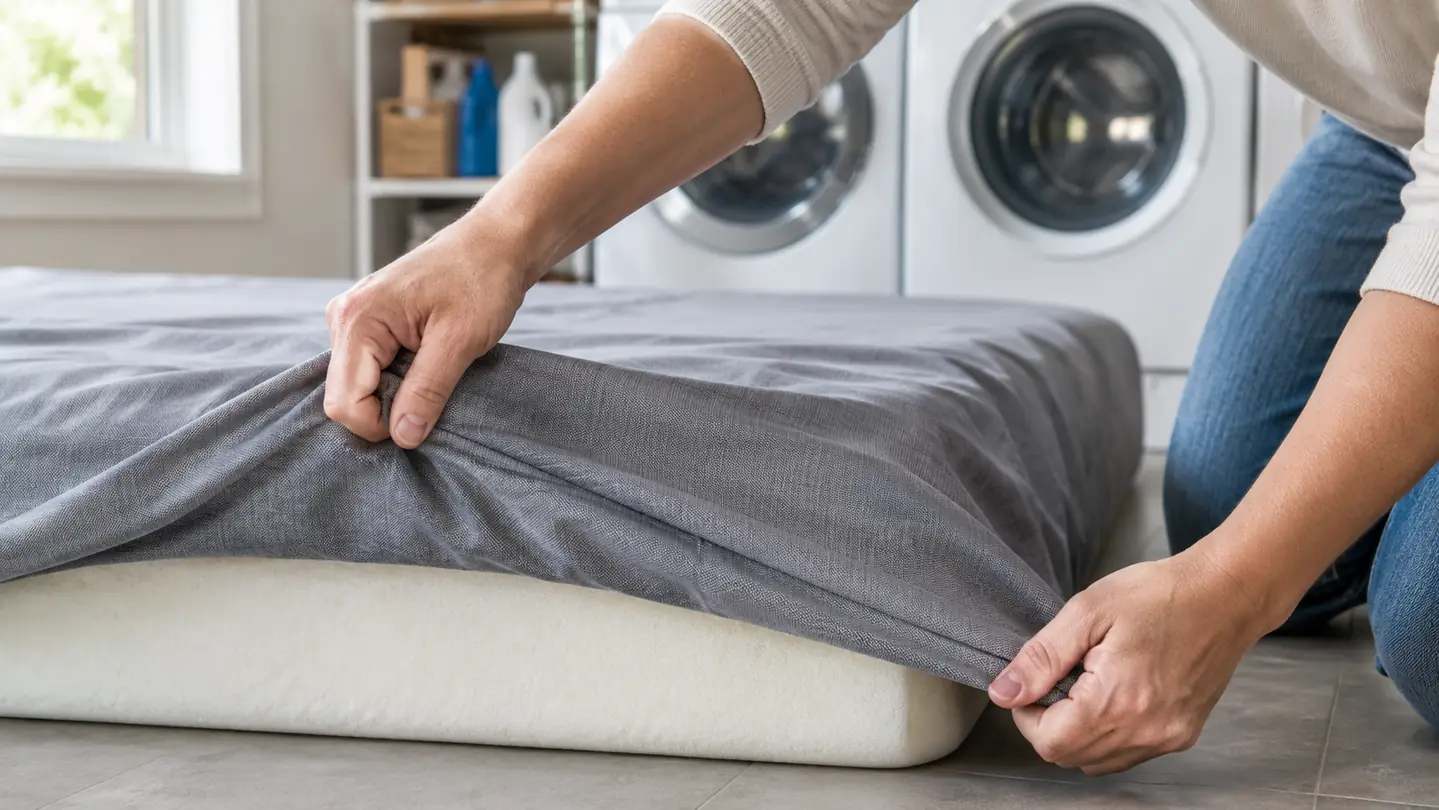
This is the part I underrated. The cover zips off, goes in the washing machine, and goes back on a still slightly damp foam base without a fight. I wash it every three weeks or so, more in mud season, and it has kept its shape. The waterproof layer underneath has done its job too. Biscuit had a stomach bug in February that I will not describe in detail, and nothing reached the foam.
The listing cites OEKO-TEX Standard 100 certification on the fabric and CertiPUR-US on the foam. I am not a chemist, so I cannot vouch for the testing itself. What I can tell you is the bed did not smell like a tire when I unrolled it, which has not been true of every foam thing I have brought into this house. That was my main worry and it turned out fine.
The four bolsters are the part Biscuit actually uses. She rests her chin on the front one and pushes her back against the rear one, and that is clearly the point of the design. But the bolsters are also the first thing to soften. By month eight the front one had lost loft and her chin sinks lower than it used to. She does not seem to mind. I notice, because I am the one who washes it.
She used to need a nudge to get off the floor at night. Now she walks to the bed on her own and settles. That is the whole review, really.
Sizing and Floor Space
The Large is 38 inches long, 28 inches wide, and 6.5 inches thick, and it weighs 6.77 pounds. Biscuit is 68 pounds and curls into a doughnut, so she fits with room to spare. A dog that sprawls out flat will hang over the edge, and if yours does, measure nose to tail before you order rather than after. That is the mistake I made with the pillow bed she had before.
It takes up a real footprint on the floor. In our living room that was fine, because it replaced a bed that took up nearly the same space. In a small apartment it would be a commitment you would feel. Mine also slides a couple of inches on the hardwood when she launches off it after the mail truck goes by. I put a thin rug pad underneath and stopped thinking about it.
What It Did and Did Not Do for Biscuit
The honest accounting, a year in. Her first few steps in the morning are still stiff. That has not changed and I do not expect it to. What changed is how willing she is to lie down again. Before, she would stand in the middle of the room looking at the floor like it had personally wronged her. Now she walks to the bed, circles twice, and settles. She gets up easier and she is less reluctant to go down again after her evening walk.
I kept a note on the fridge for the first three months, mostly because I could not tell whether anything was working and I wanted something to look at besides my own worry. The entries are boring: what time she got up, how long the stiffness lasted, whether she took the deck steps without stopping. By week six the stiffness window had shortened without any other change in her routine. Around month five it stopped improving. That is the shape of it, a step up and then a plateau.
What it did not do: it did not replace the Cosequin chews she has taken for about eighteen months at our vet's suggestion. It did not make the three wooden steps down to the yard any easier, which is what the sling on the hook by the back door is for on bad mornings. And it did nothing at all for her elbows, which are the other half of her diagnosis.
A bed is a surface. This is a good surface. It is not treatment. If your dog is limping or reluctant to move, that is a conversation for your vet, not for a product page, and I say that as somebody who has sat in a parking lot and cried over a dog's x-rays. Get the diagnosis first. Then go buy the bed, and keep doing whatever your vet told you to do.
How It Fits With Everything Else We Do
The Bedsure bed is one piece of a routine, not the routine itself. Biscuit wears non-slip socks on the hardwood in the mornings, and they cut down on the scrabbling when she is still loose. She uses a folding ramp to get into the back of our Outback for vet visits and weekend drives. On bad mornings the rear leg sling gets her down the three deck steps. The bed handles the eight hours a night she spends lying down, which is most of her day.
If I had to rank them by what made the biggest difference to her comfort, I would put the bed first, the socks second, and the rest as situational. I would not give up any of them. None of them is a substitute for the arthritis management our vet laid out, and I would be embarrassed to suggest otherwise. They are the practical stuff that makes a stiff dog's day easier.
Two Small Annoyances
The first is the fur. Whatever the cover fabric is, it collects Golden Retriever hair like a lint brush and a quick vacuum pass does not get all of it. My washing machine does. If you are the kind of person who wants bedding to look tidy between washes, this is not the most forgiving fabric cover I have owned, and I say that having owned a great many dog things.
The second is getting the cover back on. It is a two hand job, and it goes faster if you put the cover on while the foam is still slightly damp and pliable. The first time I did it, I was convinced I had shrunk the cover in the wash. I had not. Five minutes of swearing later it was on, and every wash since has gotten easier as the fabric has relaxed.
Who This Is For
This bed is for somebody with a big, older, stiff dog and hard floors, who wants a thick foam base and a cover they can actually wash. It suits a dog that curls or tucks, like most Goldens, and a house where the bed can live in one spot rather than being hauled from room to room. If your dog is already on a supplement or medication from your vet and you are trying to make the hours she spends lying down kinder, this is a reasonable place to put your money.
It is also a decent first step for someone who is not ready to buy a ramp or a sling yet. Of everything we added after the diagnosis, this Bedsure bed was the least fuss and the easiest for Biscuit to accept. She understood it immediately. Not every purchase for an old dog goes that way, and I have the unused booties in a closet to prove it.
Who Should Skip It
Skip it if your dog chews bedding, because foam is foam and a determined chewer will find it no matter how good the cover is. Skip it if your dog sprawls out flat when she sleeps, since you will want something longer than 38 inches. Skip it if you expect the foam to stay firm for years, because it will not. And skip it if you want a bed you can hose off in the driveway, because this one is a washing machine job from start to finish.
A year in, I would buy it again
The foam softens, the bolsters lose loft, and she still chooses it every night over the floor. If your dog is stiff on the first three steps of the morning, this is the simplest honest improvement I know of in the pet bed aisle. Measure your dog before you order, then measure her again.
Amazon Check Today's Price on Amazon →